
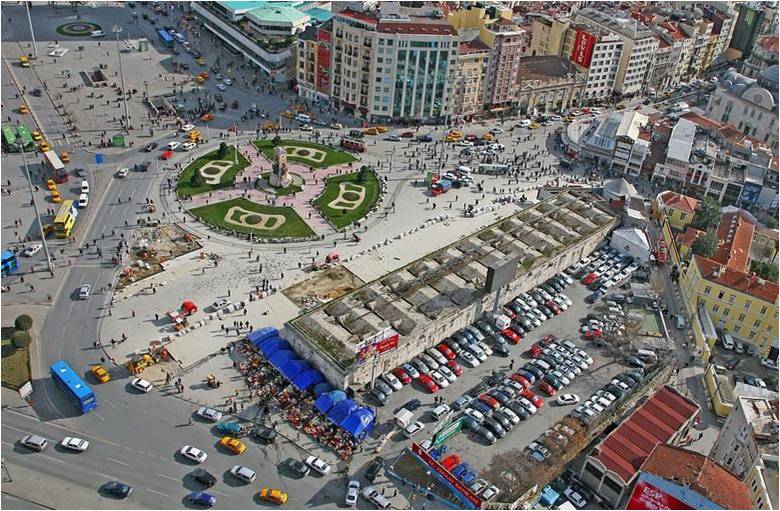

Taksim Square is a central public space and transit hub located in the European part of Istanbul, Turkey. It is a major tourist attraction with hotels, shops, restaurants, and cultural landmarks. It is also a place where public events, parades, and New Year celebrations take place. Also, one of the largest and most visited pedestrian commercial corridors in the world, Istiklal Street, terminates at the Square and connects visitors via a trolley to its international stores, lively restaurants, contemporary galleries and music venues, hostels, and schools.
While today, Taksim is a public congregation area, it ironically means “division” in Arabic: in 1730, a water reservoir stood here and the main water-lines from north Istanbul were split under this square and branched off to the other parts of the city, hence the name Taksim.
Over the past few days, Taksim Square is in news, with riot police yielding batons and firing tear gas canisters into the crowd, may remind us of Tahrir Square in Cairo. The Turkish protesters have many grievances, but one of the complaints which originally triggered the unrest was the un-checked urban development in and around the Taksim Square area. In recent years, the AKP Government has proposed plans for the development of a mosque for 30,000 people and a shopping center fashioned after an Ottoman Era military barrack for Taksim Square. Whatever the merits of these proposals, it is apparent that a large number of Turkish residents do not view them as favorably as the government does. The Prime Minister of Turkey, Recep Tayyip Erdogan, recently said in a speech that:
“Yes, we will also build a mosque. I do not need permission for this; neither from the head of the Republican People’s Party (CHP) nor from a few çapulcu. I took permission from the fifty percent of the citizens who elected us as the governing party.”

Now the question is, should the residents of Istanbul have a greater claim and say over the fate of public open spaces in their city?
Before the contemporary democratic era of Turkey, the Kings, Sultans, and other nobility laid exclusive claims to these squares and open spaces (maidani). These spaces were marked by obelisks or other monuments, and had great cathedrals and facades opened onto them. In these central squares, powerful leaders pranced with pomp and ceremony, ingrates and rebels lost their heads, and occasionally masses riled up to put the authorities in their place.
Today, the general populace has also laid a legitimate claim to these spaces. The residents of Istanbul have gone out in defiance to show their displeasure about the lack of public voice and participation in the development of their neighborhood and public spaces. This is something that has resonated far across other cities in Turkey, including Izmir and Ankara. Can the government and development community in Istanbul open up the planning approval process to public scrutiny and make it more transparent? Can there be impartial planning councils and neighborhood committees making the planning process more bottom-up than top-down?
Istanbul is an old city joining two continents and multiple great civilizations; perhaps there should be a better way to achieve consensus on how to protect and enhance the city that has been around for more than two thousand years.


Leave a Reply