
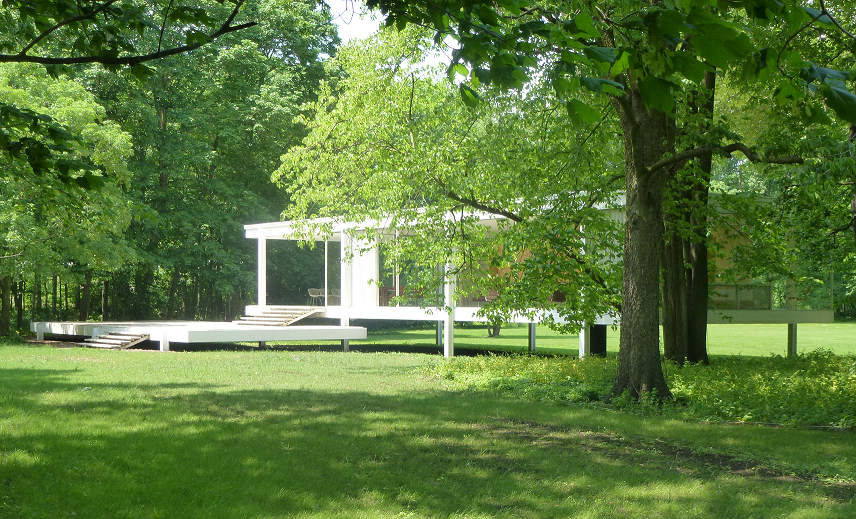
This spring I made my first visit to Chicago. And while I did greatly admire the architectural richness of that city, making a visit to the nearby Farnsworth House was irresistible. Built in 1951 near Plano, Illinois, the residence designed by Mies van der Rohe is considered one of the most famous examples of modernist domestic architecture.
In order to get there from Chicago, driving was more or less my only option. So I rented a car and set out to make the 57 mile drive, which took me from The Loop to the very fringe of Chicagoland’s ex-urban orbit. I passed through a distinctively American landscape of seemingly endless expressways, subdivisions and outlet malls, before finally making it to my destination after 75 minutes of driving. The sacrifice was absolutely worth it.
Today, the Farnsworth House is operated by the National Trust for Historic Preservation as a house museum. Not even ten years ago, the house was being auctioned in New York City. Back then, it didn’t yet have landmark status (it only became a National Historic Landmark in 2006). The National Trust, together with Landmark Illinois, feared that the house could be dismantled and moved to another state by any prospective buyer, an “architectural disaster of the first order”. After the announcement of the auction, a fundraising campaign was initiated by the two organizations, which successfully were able to outbid other buyers at the auction on December 12, 2003. The house was purchased at a cost of $7.5 million. With that history, it’s understandable that a $20 fee is charged for a guided tour of the house (though you’ll need to pay $30 if you also want to take photos of the interior).

The Farnsworth House was commissioned by Dr. Edith Farnsworth, and was designed as a weekend retreat. As often seen with Mies van der Rohe’s works, the client was one of his personal friends. Specifically requesting that Mies’ would design the retreat, which sits by the Fox River, as if it was for himself, Dr. Farnsworth intended for the building to be an iconic work of modernist architecture.
I visited the Farnsworth House just after noon. At first it was sunny, which made for the ideal circumstances to get a first glimpse of the residence. The way the sunlight fell on the house made it look almost magical.

The House’s setting brings out the best in its design. The open grass, surrounded by woods that populate the floodplain of the Fox River, creates an uplifting synergy of nature and architecture.

An observation by architecture critic Paul Goldberger, who holds the Joseph Urban Chair in Design and Architecture at The New School, sits in a small exhibition space at the visitor center of the Farnsworth House and neatly captures the experience he had when he visited the house in 2003:
“… a sublime architectural experience of extraordinary power, as exhilarating as a skyscraper and as profound as a cathedral. […] you could think this is nothing but a glass box with a white frame- but this house is about as simple as a Zen Garden: utterly spare, perfectly composed. Some people will never understand it, and others will find it something that can only be described as spiritual.”
Goldberger goes on to say that “the Farnsworth House does not try to imitate nature but rather to coexist with it, its base hovering over the land as if the very point of this building were to show how architecture can tiptoe gently over the earth. The whole notion of a floating building has a kind of magic, as if it were an act of architectural levitation.”

The complete harmony with its surrounding natural setting is indeed one of the things that I experienced during my visit. This is in part achieved through the floor to ceiling glass windows of the house, a feature that also comes back in his earlier work, the Lemke House. And, like in the Lemke House, this has the effect of visually connecting the interior of the house to the landscape outside it. Two horizontal slabs form the roof and the floor of the house. The slabs are extended beyond the edge of the building and the columns, creating a pair of cantilevers. In keeping with the honest modernist tradition of exposing structural elements, the slabs’ edges are characterized by exposed steel, painted white. As said, the house is elevated over the terrain; eight wide, flange steel columns, attached to the sides of the floor and ceiling slabs, lift the house over the floodplain of the nearby river. A third slab forms the transition between the house’s porch and the ground.

Inside, the house essentially seems like a single open room, with freestanding elements suggesting the areas where one sleeps, cooks, dresses, and hosts guests. The interior is very flexible. A small core accommodates a mechanical room, as well as a bath room. Though never realized, Mies allowed separation of the house into three rooms by virtue of ceiling details that could accommodate curtain tracks.
The house has been carefully maintained since its completion. In 1972, the house was restored to its original condition by the architecture firm of Mies’ grandson, Dirk Lohan. After the house was flooded in 1996, extensive restoration works were needed to undo the damage that was done mostly to the interior. The house was originally built to resist floods in 1951. Since then, development in surrounding areas have led to higher flood levels, placing the house at risk. It would be impossible for us to view the house in its nearly historically accurate condition today if it wasn’t for these two major restorations.
Today we can recognize the design philosophy of the Farnsworth House in a later work of Mies van der Rohe, the S.R. Crown Hall building in Chicago (completed in 1956) which fittingly houses the Illinois Institute of Technology’s School of Architecture. Considered to be one of the crown jewels of Mies’ career, S.R. Crown Hall also features a floating terrace between the building entrance and the ground, mediating the visitor’s entry into the building.

Its interior also is entirely column-free, despite its vastly larger size. Adding to the similarity is the fact that the primary form-giving elements of the building consists of two horizontal slabs that make up its floor and ceiling. It is rightly considered to be a further refining of the aesthetic he pioneered with the Farnsworth House.

Philip Johnson’s Glass House in Connecticut is a great residence in and of its own but falls short of the Farnsworth House, from which it borrows its basic concept, in several ways. The most striking of these is that the Johnson House emerges from a brick foundation. This makes it more of a singular object placed in a scenic location.

The fact that Mies places the Farnsworth House on an elevated slab gives it its magic and makes the space around the residence feel like a halo, “as much a part of the house as the space within,” to again borrow the words of Paul Goldberger. The black exterior of the Johnson House realistically aligns with the earth tones around it, whilst the Farnsworth House’s white exterior give it a more celestial appearance. The entrance to the Johnson House is markedly less defined. The terraces which Mies uses to guide visitors into the building, are what makes visiting them a little bit more processional, not unlike visiting a Greek temple.

Whilst of the Farnsworth House is a very bright expression of the time, it possesses a timeless quality and is perhaps the finest example of modern minimalism. Its importance is reflected by the fascination in the minimalist house shown by a new generation of design professionals and enthusiasts.
All photos are taken by the author, unless noted otherwise.


Leave a Reply to Incredible Mid Century Modern House | Mid Century Modern GroovyCancel reply