

“Tear down this wall”.
President Reagan referred, of course, to the Berlin Wall, which was behind him alongside the Brandenburg Gate. That gate — a historical entrance to the old city which saw Napoleon, the Prussians, the Imperial German Army, the Nazis, the Red Army, the Stasi, and so many others pass through — soon saw Berliners pass through once more.
But beyond and beneath the pedestrians (and equestrians) is the U-Bahn. Part of Berlin’s public transportation system, the U-Bahn (“Underground Way”) is being extended underneath the most important avenue in Germany, the Unter den Linden. This is the street that the Brandenburg Gate stands upon; this is also one of the streets that was cut off between the former West Berlin and East Berlin. Now, transit infrastructure is playing its part in the reunification of a city, a country, a continent, and of course, families and friends. Indeed, while the opened gate may symbolize the reunification of the city, it is the infrastructure underneath the gate that gets the job done. (U-Bahn trains are all decorated with Brandenburg Gate icons on their windows).

U-Bahn Construction Along Unter den Linden (Towards Brandenburg Gate)

Brandenburg Gate Icons on U-Bahn Windows
Of course, this is not without precedent. Railroads helped to build and unify the German Empire during the industrial revolution, and most railroads terminated in centrally-located Berlin, the capital of Prussia. Many of these lines remain as parts of the public transportation network of the city today, including the city loop, and other S-Bahn (“Suburban Way”) lines, which go outside of the city, and which go faster than the U-Bahn.

S-Bahn City Loop “Ringbahn” (+Freight & High-Speed ‘ICE’ Railways) on Deutsche Bahn Property
While the Berlin U-Bahn, the oldest subway in Germany, is maintained primarily by BVG, a city transportation agency, the S-Bahn is maintained by Deutsche Bahn (DB), Germany’s state railway company, which also runs regional and express trains, sometimes with cooperation from other countries’ railroads for international travel. DB operates similarly to a public-private partnership, as it is a private company, but the majority of its shares are owned by the Federal Republic of Germany (so it is heavily subsidized).
DB is also profitable; indeed, even after deducting for infrastructure costs, the company is in the green. This is due to many reasons, such as the fact that DB also carries freight, and the relatively dense urban corridors of Germany. Many Japanese railways are also profitable due to the popularity of the lines (and the density of the country), and the MTR in Hong Kong also manages to make profit largely due to real estate revenue (such as shopping malls in stations). Furthermore, the Port Authority of NY and NJ also does not receive government money; as a public authority, it collects “sufficient” revenue from its tolls, ports, and real estate. Amtrak, however, operates many unprofitable routes, and even though the Acela Express’ revenue exceeds its operating costs, Amtrak as a whole is in the red. It does not operate freight, nor does it own most of the infrastructure that it uses, with the exception of the Northeast Corridor. (Then again, many public highways are also unprofitable despite tolls, so it is not only rail, and perhaps profitability is not as important as efficiency when it comes to public goods).
Back to Germany. As mentioned, DB does not maintain most of Berlin’s transportation. BVG works the city’s buses, trams, ferries, and other programs which do not venture outside of city limits. Why am I explaining this? It is necessary to understand the economic and political management entities of Berlin’s transportation network because during the Cold War, these agencies did not exist in their current form.

(Former) West Berlin U-Bahn

(Former) East Berlin S-Bahn
East Berlin and West Berlin had their own respective agencies. However, East Germany surrounded West Berlin, and thus, controlled the trains that extended beyond West Berlin limits (such as to Potsdam) via the GDR’s version of today’s DB. This meant that the S-Bahn, which went through West Berlin, was controlled by East Germany. West Berliners could ride these trains (thereby subsidizing communism with a Western currency). They could also enter East Berlin on these trains for extremely cheap shopping, after exchanging a hefty sum of cash for essentially millions in East German currency. Sometimes, West Berliners would also enter Eastern territory to catch up with friends and family, and then say good bye again at the train station, not sure if, or when, they will see them again.
However, after a decade or so, West Berliners ended up boycotting the S-Bahn, and East Germany stopped servicing West Berlin entirely. After all, the East Germans would sometimes even paint their trains with communist propoganda, which would then travel in West Berlin stating “Americans Go Home”. Even though no East Germans could ride S-Bahn trains into West Berlin, East Germany still owned the trains that went into the Allied sector.

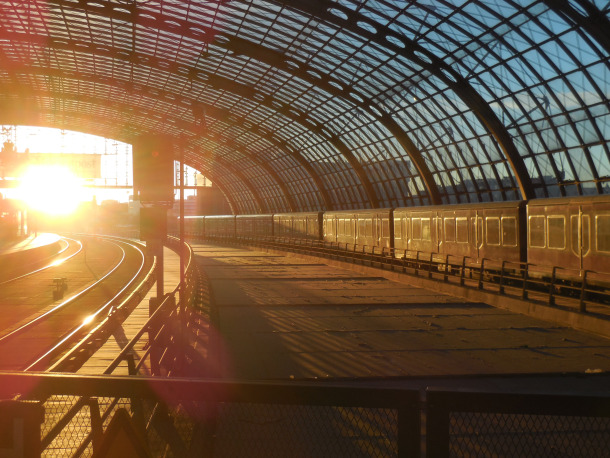
S-Bahn at Sunset
Besides boycotting the S-Bahn, West Berlin also followed the path of many other Western countries by removing its trams and replacing these routes with buses. They also built more U-Bahn lines, largely because they had no S-Bahn of their own. Interestingly though, because the (British, French, and American) West German city was walled off, suburbanization never took hold as strongly as in other Western cities at the time. Meanwhile, the poorer East Berlin did not have the money to build many new U-Bahn lines, let alone repair the current system. In fact, bullet holes from the war remained in many stations for decades; there are still bruises on many buildings in Berlin today. Over the years, West Germany’s roads and trains continued to be updated, while East Germany’s roads grew larger and larger pot holes, and the trains become more and more archaic. So, while they covered up U-Bahn connections with the West, they also built a few new U-Bahn lines of their own (a small amount compared to the West). Moreover, they solidifed their East German S-Bahn, and they extended their tram network. Today, these tram routes still operate, and they only operate in former East Berlin. It’s a great way to orient yourself in the city today, besides the communist architecture in East Berlin, compared to zilch in West Berlin.

Alexanderplatz, A Famous East Berlin Hub (As Seen in “The Bourne Supremacy” Movie)!

Tram Right-of-Way Keeps Traffic at Bay
Besides creating a communist shopping center for West Berliners in Friedrichstrasse Station (an East Berlin S-Bahn hub), East Germany also gained revenue from West Berlin’s U-Bahn, which went under East Berlin territory at certain points, and could not stop at the “ghost stations” that existed in GDR territory. The West had to pay in order to use this land, and GDR border guards would patrol the unused stations as Western trains passed underneath East German territory. In case anyone tried to break the windows and board the train, the border guards would be there to stop the treason. These stations also did not show up on East German maps, and neither did any other details about West Berlin; it is as if the entire Western portion of the city did not exist. These stations slowly became dirtier and dustier, until being revitalized once Germany was reunified. At least they were not completely destroyed, like many damaged stations that would have connected East and West after WW2.

Revitalized Former ‘Ghost Station’ on the U6 Line
The Autobahn also was retrofitted with border checks. West Berliners could use the Autobahn in East Germany, but usually only if they remained on the actual Autobahn all the way until reaching West Germany. Their trucks were sealed so that no stowaways could board, and an average travel time was known so that if more time was taken, it may have meant that Westerners stopped to ‘spread capitalism’ by talking to locals. However, all of this was possible only after the resolution of the Berlin Blockade, which occurred during the first few years of the Cold War. At that time, one could only fly from West Berlin to West Germany, which is how the Allies supplied the city from Tempelhof Airport, which the Nazis had previously substantially enhanced as part of Albert Speer’s “Germania” project. (This airport is now too small to function properly, and is currently in the twilight zone of redevelopment proposals while Berlin uses two other airports and constructs a larger, third and final one to take over the jobs of the current two).
In the end, though, the point is that the city’s network became highly fragmented, and if a route could potentially bring East Berliners into West Berlin, then it was abandoned or patrolled at the border. Public transit was used during the Cold War in order to ironically immobilize East Berlin from West Berlin, and in order to fence off West Berlin from East Germany, which surrounded the “city-state” of West Germany. Indeed, while transportation is meant to mobilize people, it apparently can also be used to immobilize. Entire sections of the Berlin Wall and its no-man-zone death strips were built alongside railroad routes, where physical borders already existed to a certain extent. Entire neighborhoods were razed for the construction of the wall, similar to how a highway may have been built. But this highway would have no cars on it; instead, it would be a death strip maintained by border guards, sometimes built over (former) train stations and entire squares.
Potsdamer Platz is one such square. Potsdamer Platz used to be a gateway from Potsdam, the capital of the state of Brandenburg, into old Berlin. It evolved into a major social, economic, and physical intersection of the city. It was also apparently the site of the first stop light in the world. But the Wall literally leveled what was left of the area post-WW2. Today, the square has been rebuilt with skyscrapers and shopping centers. It is also a major intermodal hub, and the Deutsche Bahn has its offices there in one of the tallest skyscrapers, right next to a section of the Berlin Wall which was left standing, and right next to a nearby McDonald’s as well. Transportation infrastructure has been fused with the reunification of the city on a former death strip. To repeat: there was literally nothing at the site during the Cold War, when it was a no-mans-land death strip at the periphery of both cities. Now, it is at the center of the reunited city, and transportation infrastructure has played its part in this redevelopment. Indeed, the DB Headquarters is there!

Former Section of Berlin Wall Juxtaposed Near Potsdamerplatz Train Hub and DB HQ Building (L)

Live, Work, and Play at Potsdamer Platz (Sony Center Offices, Shops, IMAX Cinema…)
Besides Potsdamer Platz, there are even pedestrian and bicycle greenways encircling the periphery of West Berlin, as these spaces were reclaimed from the Wall, which separated GDR countryside from West Berlin. Also, on (formerly) vacant land usually next to highways or railroads, the government strictly regulates the ownership of small plots of land for weekend family retreats. People live in small cottages temporarily on the weekends and may also tend to a small garden; essentially, these are “urban farms” that began approximately one hundred years ago as a program to give vacant land to workers who otherwise could not afford to leave their crowded tenements and get some time away from rapidly-urbanizing Berlin. While some of these tracts are quiet and secluded by trees, others remain literally next to roads and railways, but at least they were an escape from the crowded tenements.


“Schrebergaerten” Shacks Alongside Tracks
The remnants of the Berlin Wall are clearly only a small part of the fascinating and contradictory nature of Berlin. Prussians, Kaisers, Weimar Presidents, Nazis, Soviets, Turks, and countless others from Karl Schinkel to the Bauhaus, have built Berlin. They also have shaped the city’s transportation network, from Hitler renaming a subway station after himself and placing swastikas in every station, to the Brandenburg Gate and the new U-Bahn line being built underneath it today. (Also, streets in East Berlin were named after communist heroes, but many have since been renamed).
Yet despite (and perhaps because of) all of these destabilizing contradictions, Berliners are relatively orderly and punctual. Indeed, many Germans have told me that they enjoy following rules. Almost every pedestrian waits at a crosswalk until the light turns green, even if there are no cars on the road. Almost (but not) every train arrives on time and schedules are displayed on every single station. Also, stops are announced even on buses (although electronic ETA signs are not posted at bus stations, so when buses arrive earlier or later than scheduled, one can end up waiting for a very long time). Moreover, bicycle lanes and bicycle sharing locations are prominently located near most stations, and there are spaces for bikes on trains, trams, and buses; however, in order to bring a bike onto a train, one needs to buy a ticket for the bike. (Electric) car sharing programs are prevalent; moreover, one can go online and find drivers already heading somewhere, wanting to split the cost of gas amongst other people. Furthermore, the “line” between a shopping mall and a train station is blurry in Berlin, as many stations have numerous retail outlets, providing extra revenue for the transportation agency, and providing jobs for neighborhoods. And finally, some other cool things in Berlin: mailmen, mailwomen and other delivery officers riding bicycles, entire families riding bicycles together daily, extremely small city cars, and electric car charging stations. (Berlin does not have the best bike infrastructure, either, so it can be dangerous at times… a lot of the time, though, the bike lanes are on the sidewalks).

Berlin Hauptbahnhof, Central Station (Finished in 2006 w/ North-South Tunnel); Notice Tracks Above and Below!

Bicycle Parking at S-Bahn Station

Deutsche Bahn Bike Sharing Program (Next to Tram)

Electric Carsharing Stations

Smallest Car (Which I’ve Seen!)
(This car is parked next to a parking lot where a synagogue once stood before being burned by Nazis and turned into storage space for Nazis, later to be irrevocably bombed and destroyed in the final days of WW2)
However, many of these examples are relatively common not only in Berlin but in Germany, and some other Western European and Northern European countries. After all, European cities are generally older, and many were not originally designed for cars. Some have built parking lots underneath their historical centers. But it is expensive to find parking, and even in one’s own neighborhood in Berlin, one needs to pay in order to have a parking permit. Also, due to various historical forces, respect for society is “generally” greater than respect for individuals, so taxes are higher, energy is a lot more expensive, and public transportation is a lot more abundant. (People also tend not to have dryers in order to save money, and train doors open individually, if a button is pressed, so as to conserve energy).
What is unique about Berlin and other German (and Austrian) cities is that there are no turnstiles to enter or to exit the entire network. While some light rail systems in the U.S. may utilize the “honor code”, the entire system in Berlin does this. The Los Angeles Metro recently switched to turnstiles from the honor system, which it had used in order to entice riders to try out public transit. However, so many people never paid and just went through regardless, which apparently is not a problem here, where people generally follow the rules. There are few security cameras, and few police officers. And if they don’t, plainclothes officers do randomly check passengers for their validated tickets, and there is a hefty fine. As it stands, people can simply walk into a station and get onto a train; there is nothing in between to stop them. If this was the case in New York, I am confident that New York would also install turnstiles, as L.A. did. (Even with turnstiles in New York, many people jump over them).

Plainclothes Officers Fine Two Unpaying Passengers; Notice Bike Sign/Area on Train
In essence, transportation infrastructure expresses powers, identities, and ideologies. It has been used in Berlin to divide for war and reunify for peace. And even though Berlin is a dramatic example, it is only one of countless, countless, countless examples of social, economic, and political infrastracture interconnecting with the physical environment.
Think of Jerusalem, a city with a history of walls dating back thousands of years, and its current transportation system. Israel recently completed a light rail network, which travels in West Jerusalem (primarily Jewish) and East Jerusalem (primarily Muslim), both of which are within Greater Jerusalem and not behind the West Bank security fence. Athiest Jews, ultra-Orthodox Jewish men and women (unseparated from each other!), Israeli Arabs, Palestinians, tourists… they all use the system, which is in Hebrew, Arabic, and English. Indeed, the tram is a melting pot largely unseen in the rest of the city. Yet as with everything in Jerusalem, the line is inherently controversial. In the simplest of explanations, most Palestinians see East Jerusalem as part of a future state of Palestine. If Israel is building a tram through there, and bringing more Israelis into the area, then they feel threatened, even though the tram is also helping residents of East Jerusalem with greater mobility and greater access to the city, as a tram would do similarly in other cities. Of course, the situation is extremely complex.
Back to (literally) bankrupt Berlin, which has torn down its “walls” both on the streets and below (I am not sure if Berlin ever had turnstiles for its subway). The only turnstiles left in the city that I’ve found are in public bathrooms (and privately-owned ones as well), which usually require 50 cents to use. Clearly, the honor code does not seem to apply for Germans here. But the honor code is absorbed by the transportation network. People will honestly wait at a crosswalk, even if no car is around, for as long as the light is red, just as a car would do the same in the U.S. This means minutes of standing at the corner of a quiet street without moving to the other side. But they do end up moving to the other side, be it the other side of the street or the other side of the former Wall. This level of obedience does not occur in other regions of Europe, where few people stick to rules and even fewer stick to schedules. In Rome, for instance, trains rarely arrive on time, and the system is a lot less organized and a lot dirtier. They do play music in the stations, though.

Following the Rules @ Major Intersection (Former GDR TV Tower in Background)
But back from Southern Europe to Germany: in the end, it’s hard to wrap your head around what life was like in Berlin. Before the Wall was constructed (essentially overnight), thousands were fleeing East Germany, or working in West Berlin and living like royalty with Western currency in East Berlin. Indeed, many took trains back and forth with all of their belongings into West Berlin, trying to permanently relocate secretly.
Once the Wall was built, all of this movement stopped. The center of the whole city became the peripheries of the two cities, countries, and ideologies, as if 42nd Street in New York became a huge wall and Times Square, Bryant Park, and Grand Central Terminal were demolished and turned into vacant land, and the subways were severed on both sides. This land would no longer be valuable, and the respective centers of the two cities would move northward and southward. Maps for North NY would not show any details about South NY, as if it did not exist. And then the cities would be reunified decades later. Slowly but surely, one piece of the wall removed at a time. Vacant land would be redeveloped, connections would be rebuilt, and economies would be resynced. New York, in this example, would also tear down its theoretical wall. Transportation infrastructure, once designed in order to keep people from each other, would be redesigned to bring them together. But one thing would be different: the turnstiles.

New U-Bahn Line Under Construction at Unter den Linden; Notice GDR TV Tower in Background

Unter den Linden (L) leading into Tiergarten (Berlin’s Central Park); Notice Brandenburg Gate Between Park and Construction Cranes for U-Bahn, and Reichstag (Center R)
Rayn Riel is a student at Tufts University studying international urban development, his self-crafted major. Interested in transportation, he is the founder of Tufts’ only undergraduate urban development student organization and was an intern at the NYC Department of City Planning in Brooklyn in order to work on transportation accessibility and mobility in East New York. A writer on PlanYourCity, he has had planning work and research experience in the Americas, Asia, and Africa. This post is a result of his Spring semester urban planning study abroad program, currently in progress in Berlin and other European cities.
(All photos are taken by Rayn)
Additional photos…


… By the way, when Amanda Burden led the NYC Department of City Planning (DCP), she focused on urban design and understood that humans are animals with particular sensibilities. DCP published Active Design Guidelines, focusing on sidewalks. Apparently, (most) people have two feet, and when they are not in a vehicle, they use these feet to walk, and they also use their other senses to move around. Beyond the physical space, the time of day, the individual’s mood, and the walk’s purpose, design can contribute to an enjoyable, interconnected, interesting, and inviting experience.
DCP created a useful list of design factors, ranging from sustainability, resilience, safety, human scale, complexity, and continuous variety to connectivity and accessibility. There’s the local climate to consider when planting. There’s lighting, gradients, and materials to ensure safety throughout the day and night. There are methods to create continuous variety, and to consider the different speeds and activities along the sidewalk. There’s also a lot to do. We have been designing for automobiles for decades, which do not have pedestrian sensibilities.
Cognitive architecture usually refers to the structure of the human mind. But cities are a result of the human mind – or at least, the mind of those in power. What about designing for those who cannot see, hear, or think clearly? Planners should practice exploring cities through the perspective of a disabled person, or a child, or a senior. Places need to be inviting to all kinds of people if they are going to become as dynamic as possible.
Designers should also explore informality, and leave room for flexibility and for freedom of mobility. Sometimes, transportation infrastructure becomes ironically immobile. If a path is being forged by the informal user experience, it should be noted, and not just brushed aside. Here is a photo that I took in Berlin, showing how human beings use the space, compared to how it was designed:

Clearly, people want to traverse along the median, where there are grasses and trees. Many run along this area, or bike. Personally, I enjoy being sheltered by the trams on either side. Maybe the city should build a bike lane here, alongside a walkway, and some benches and lighting? Of course, the city may be worried that people may hop towards the median, and hit an oncoming tram, but there are surely ways to prevent this and manage the space.

Additional reading: “The Horrors of Communism”… Interesting perspective…
When people ask what East Germany was like, most already have their own preconceptions. And why not? I certainly did before I lived there. Those of us who traveled to East Berlin on MWR shopping trips saw very little of East Berlin, and nothing of the GDR.
Suddenly, the ornate, colorful facades that have replaced the drab gray GDR-era facades in Prenzlauer Berg are no longer so attractive to those who begged for the end of Socialism. When the bullet-ridden facades disappeared, so did their subsidized rents.
That meant that they, too, would eventually have to disappear. Is it any wonder that Berliners cringe when they hear the new residents (many of them government employees) chatter in their Swabian and Rhinelander dialects while searching for expensive condos in East Berlin?
In 1989 you could have become a millionaire selling bananas to East Germans after the Wall opened. Now, most don’t give bananas a second look, mostly because it is a luxury they can longer afford since their rents are usually 50% of their income.
Everything in the east was the object of derision: West Germans made fun of the old East Berlin streetcars – twenty-five years later, the lines are being extended to the West. West Berliners also mocked the ‘inefficent’ Reichsbahn and the East Berlin S-Bahn: In 2011 the S-Bahn – completely insolvent and dependent on regular Deutsche Bahn cash infusions, suffered a major collapse in the winter. It had been reduced to bare-bones operating funds. To keep profits maximized, maintenance had been reduced and trains had been taken out of service (because they were GDR-era trains!) Then tracks and switches froze in the bitterly cold winter, causing mass chaos. Commuters went into revolt. The only solution was to re-hire the people who had been let go, and to quickly (and quietly) place GDR-era trains back into service. The ‘primitive’ practice of GDR railway workers pouring liquid manure on the frozen switches to keep them functioning in freezing weather was no longer quite so silly, and even the anti-GDR publishing house, Springer Verlag, announced angrily that ‘even the GDR could do better!”
Those of us who lived in the GDR can only smile when we see the now reunited city of Berlin in a state of constant fiscal collapse. East Berlin went bankrupt subsidizing the working class; reunited Berlin has gone broke stupidly rebuilding the imperial castle and subsidizing the wealthy. Berlin ‘s debt is greater than that of the GDR’s at its highest level. Not only the pretty buildings in Prenzlauer Berg are a facade, so is the imaginary wealth of this once great city. It is all a facade.There is a certain hypocrisy that one encounters in Berlin, and the bottom line is: Socialism doesn’t look quite so bad anymore.
The GDR was my home. It was there that I stood in line for fresh paprika from Hungary or oranges from Ecuador. I traded good Berlin beer for asparagus with friends in the Brandenburg countryside.Country eggs changed hands for ketchup from Albania. It was a place where all the resident of an apartment building took turns cleaning the common areas, and where the children collected paper and bottle caps for recycling. I heated my apartment with dirty, sulfurous (and cheap) brown coal, a smell one seldom encounters in Berlin today. That coal was delivered by a soot-covered man with a horse and a wagon. Tickets for public transport were mostly on the honor system: you could take one without paying. But why wouldn’t you pay? After all, the price was almost nothing!
Yes, I stood in lines in the GDR. I stood in line not because there wasn’t anything, but because they wanted to make sure as many people as possible got their share. Did the system always work? No. Was there abuse? Sure. But, unlike in the West, no one ever went hungry. EVER. Our apartments may not have been the most modern or stylish, but no one was homeless. EVER. Some things are non-negotiable. Unless you live under capitalism.
Unlike most East Germans, I had lived in the West and I was able to compare things for myself. Despite the daily frustration of life in real-existierenden Sozialismus (real socialism, as it was called), I actually preferred my life in the East. It was simpler and it was easier to be happy.
A program I recently watched maintained that people are their happiest not when they have all that they want, but rather when they have all that they need. This may be the reason that East Germans, despite many of the so-called deprivations, were happier than many of their West German cousins. The problem was, they just didn’t know it. Today, two decades after unification, former East Germans know what they gave up. And they gave it up for bananas, video recorders and a Golf GTI. And as Germany grapples with record numbers of welfare recipients and unemployed, suddenly Socialism doesn’t look quite so bad. That’s right, I said it again.
I was able to take two vacations a year (albeit not to the West), put money in savings and eat well, even by Western standards. I made good money as a member of the MfS (1400 Marks a month), but my former partner W. was a truck mechanic. And he made more money than I did repairing Russian dump trucks!

Leave a Reply