
By Alyssa Campbell

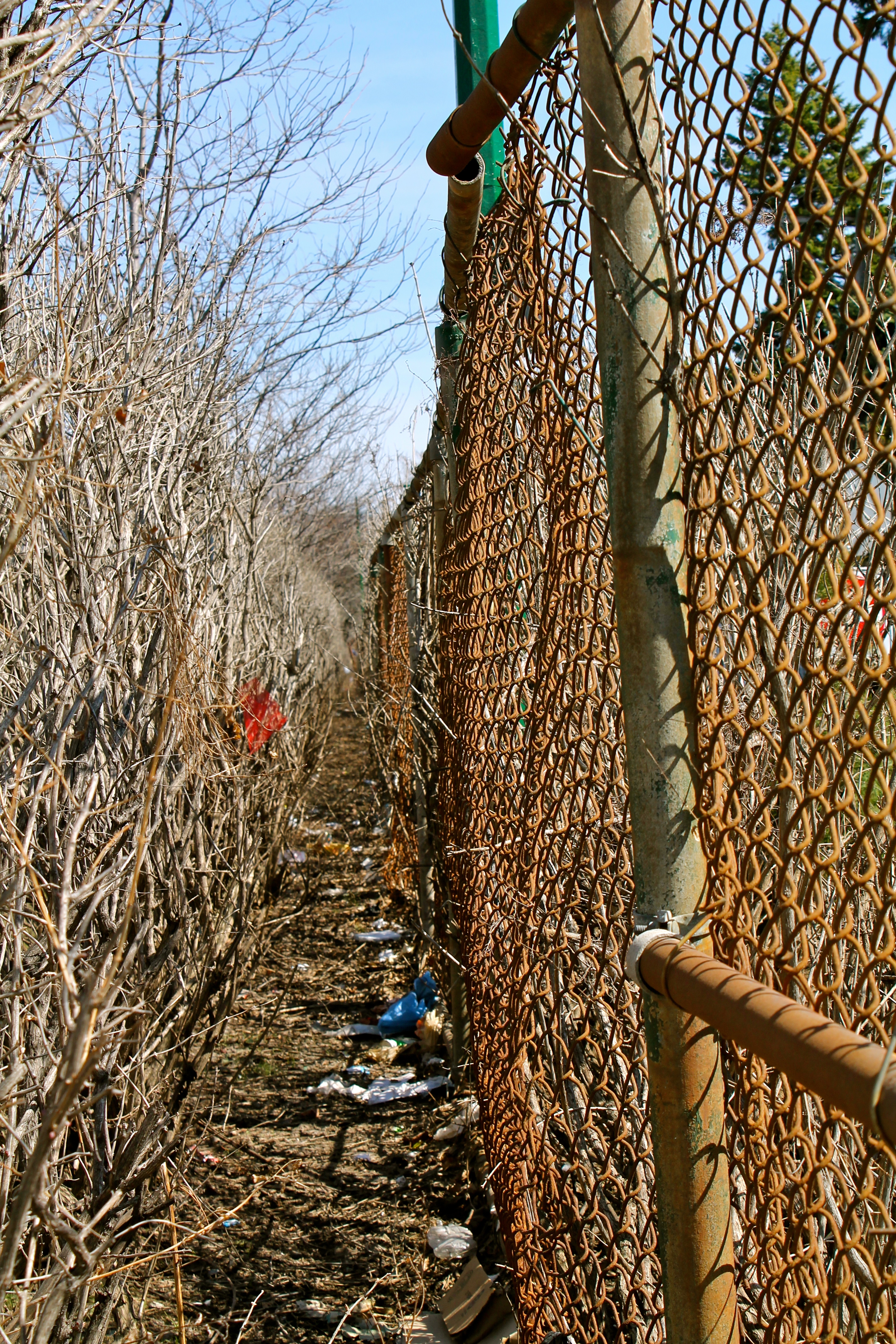
When driving along Montreal’s Boulevard de l’Acadie, you might at first only notice on one side of the road a line of shrubs with suburban houses in the background. However, upon closer inspection, the existence of a six-foot tall chain-link fence separating Montreal’s poorest neighborhood from one of its richest becomes readily apparent. This fence, separating the Town of Mont-Royal and the neighborhood of Parc-Extension, is representative of the physical segregation that can occur even in a city like Montreal that has a long-standing reputation of tolerance, openness and diversity.
In 1960, residents of the Town of Mont-Royal lobbied for the construction of a fence along its border with Parc-Extension with the reason that it was absolutely necessary for the safety of their children against the traffic of the Boulevard de l’Acadie. However, to many the fence carries an obvious tone of intentional class segregation. It is a physical means to prevent the low-income residents of the neighborhood Parc-Extension from entering the affluent Town of Mont-Royal. In 1966, students from the Université de Montréal tore down parts of the fence in the midst of a riot, declaring it class separation. However, the fence was quickly restored by city officials. While politicians from Parc-Extension have made pledges to tear it down, the former Mayor of Mont-Royal stated that his constituents have a “psychological need” for the fence. During a recent Halloween, the fence’s gates were locked to prevent children from Parc-Extension from trick-or-treating in the Town of Mont-Royal. On a recent visit I made to the fence, the gates still remained locked – an ongoing message that no one, not even children, are welcome – if only because they come from Parc-Ex.


The stark differences between Parc-Extension and the Town of Mont-Royal cannot be overemphasized. For their close physical proximity, the two neighborhoods are polar opposites. Although surrounded entirely by the city of Montreal, the Town of Mont-Royal has been its own municipality since it de-merged from the city in 2006. Its tree-lined streets, large single-family homes, and freshly mowed lawns are representative of how a privatized urbanity can emerge completely removed from its immediate surroundings. Mont-Royal came into being in 1912 as a planned corporate suburb, designed to be a model upper-class city reflecting the principles of the Garden City and City Beautiful movements. Meanwhile, Parc-Extension developed as a working-class neighborhood and key immigrant hub, welcoming successive waves of Italian, Greek and now predominately South Asian and Latin American immigrants.


Parc-Extension is among one of Canada’s most diverse neighborhoods, with over two-thirds of its population immigrants and visible minorities. In comparison, the population of Mont-Royal is nearly three-fourths white. While in Mont-Royal the average household income is over six-figures, in Parc-Extension the average income is barely over $30,000 – with nearly half of the population qualifying as low-income. In Parc-Extension, 78% of residents speak a mother tongue other than French and English, while in the Town of Mont-Royal only 1% does. Demographic differences, however, only brush the surface of the divide that runs between the two communities after more than five decades of physical separation.
Social interaction is key to overcoming such tensions, prejudices and fear of a visible “other” living next door. However, as long as the chain-link fence stands, opportunities for interaction between the residents of Mont-Royal and Parc-Extension are diminished and the fence will continue to reinforce the idea that the two communities are too irreparably different to ever be connected.
Photos property of the author.


Leave a Reply to Syed S. AhmedCancel reply