
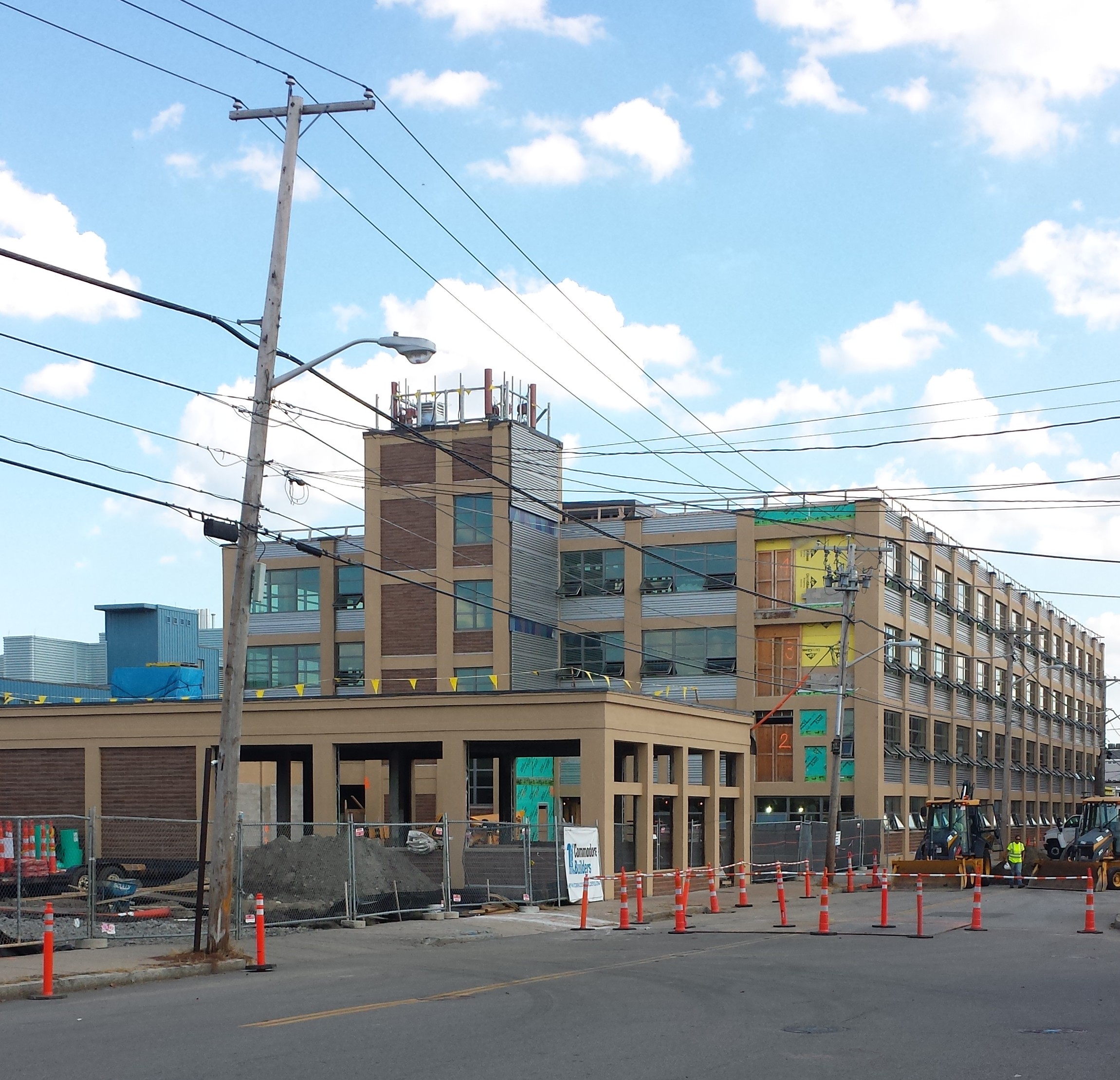
What happens when a university, which emphasizes active citizenship and creativity, ironically destroys creative space behind closed doors? It’s not the same as when a university takes over a transportation hub, or when a university takes over a neighborhood — be it in Boston or New York. No, this is a catch-22 expansion into the domain of the creative class.
Two years ago, an urban planning student organization at my school, which I had co-founded earlier that year, found out that a nearby Tufts-owned warehouse, full of artisans, was going to be renovated. The artisans were to be evicted within the next few months. So, we proceeded to explore the space, meet with artisans, and try to understand the complex, contradictory, and confusing situation. We conducted IRB/CITI reviewed research, and we began to comprehend the social, economic, political, and physical dimensions of 574 Boston Avenue.
Tufts Daily article (April 2013):
University plans to remake a Tufts-owned building at 574 Boston Ave. into teaching and office space will result in the May 31 eviction of its current residents, a community of artisans who have run their businesses there for over two decades.
Tenants on Nov. 30 received a notice from Walnut Hill Properties, Tufts’ non-academic property manager, which gave them six months to move out, according to a Feb. 4 Boston Occupier article.
“Tufts has been considering the best use for 574 Boston Avenue for several years, as the university’s need for space has been increasing,” Director of Public Relations Kim Thurler told the Daily in an email. “We will be working closely with the city and the local community as we move forward and expect to meet with the neighborhood as our plans develop further and we are closer to applying for a building permit.”
For the artisans, eviction means the demise of a large community of woodworkers, instrument makers, metalworkers and other artists who have made a home out of the four-story, 96,000 square-foot building.
John Brown, Paula Garbarino and Chris Keller (A ’76), woodworkers who design and build custom cabinets and furniture from the building, said they are frustrated at the loss of this communal workspace.
“There’s a big brain trust in that building, and it’s all going away,” Brown told the Daily. “We all can’t move to the same location because that building, that 574 Boston Ave., doesn’t exist anywhere in the area, and boy, have we looked for it.”
The building fostered a vibrant community of artisans who have shared ideas there for decades, Garbarino said.
“It is lovely to be able to go to work in your own greater neighborhood, to go to work in a place with light and air and fabulous neighbors who can give you advice and help you out,” Garbarino told the Daily. “I really value the greater community of people in that building.”
The artisans occupied the building on a month-to-month basis since all leases expired several years ago, Thurler said. Tufts has informed tenants about their intentions to renovate the building for many years.
Although the university did make the artists aware of its future plans, Keller said Walnut Hill was ambiguous about the situation until the artisans received the letter in November.
“There had been rumors floating around for at least a decade,” Keller told the Daily. “We all knew that eventually Tufts would want to do something else with the building – or we assumed they would.”
The university has been working to facilitate this move for those affected by the eviction, Thurler said.
“We have provided tenants with contact information for local commercial brokers who are well-qualified to provide relocation advice and assistance,” she said.
Despite university efforts, Garbarino said that many artisans have not found adequate spaces to relocate. For example, she has looked at 16 buildings but has not found a comparable place to 574 Boston Ave.
“When you go look at other commercial space and it’s all metal buildings with no windows and a cement slab to work on, it’s not the same – it’s not at all conducive to creative spirit,” Keller said.
Student group Urban Policy, Planning and Prosperity (UP3) is trying to help the community of artisans, freshman and member of UP3 Dirayati Djaya said.
“It’s been absolutely really shady,” Djaya said. “I think that was my biggest concern about the whole situation. The Tufts administration was socially distancing themselves from the tenants that have been there for 20 years.”
UP3 members have been meeting with the artisans and exploring the space every Friday for the past month, according to Djaya. She launched a blog to preserve the memory of the tenants, whom she said were never properly acknowledged.
“As an urban planning group, we are really fascinated by the architecture,” Djaya said. “I’ve been taking pictures, documenting the space, just interviewing [the artisans] and keeping track of all the data.”
Artisans’ opportunities to make themselves known to the Tufts community had been limited by a rule against holding open studios in the building, Garbarino said.
“There’s that kind of way to connect with your community so that they know you’re there and they learn to respect you and appreciate you and value you,” she said. “[We] are a kind of dying breed of people that are makers who are not assembling pre-formed parts in that sort of mindless way that is left to manufacturers worldwide now.”
These artisans lived and worked in an organic social, economic, political, and physical environment. The open-door space incentivized creativity, akin to Building 20 at MIT. Among the many talented artisans: Rick Berry, Paula Garbarino, Judy McKie, Kim Schmahmann, John and Jane Kostick, Mitch Ryerson, Dan Klein, and…


.
These are undoubtedly talented individuals, but they were also a collective spirit, and they’re now scattered around the region. Even if some could find new places to work with adequate lighting, those spaces were typically further and further away from home, and of course, from longtime friends and colleagues. This was a neighborhood within a neighborhood, evicted and shattered into pieces. Woodworkers, bicycle mechanics, sign makers, all gone…
…
Nevertheless, in theory, I support Tufts’ renovation. The university will be using the space wisely, and will be creating jobs in the process. They owned the building, and they decided to renovate it. For decades, artisans used the relatively cheap space, and now, it will be transformed for the 21st century. However, the 21st century deserves a better transformation.
There is absolutely no recognition of the artisans on the official redevelopment website, and I’m concerned that few (if any) will know the “true” story of 574 once this building has been renovated. I think it is important for people to know about the people who called 574 home.
This is the purpose of this article.
As such, I wrote to Tufts. Here’s the relevant part of my message:
…Don’t you think that it’s odd that the Tufts community seems to know very little about the lovely people who used to work at 574? Why is Tufts not mentioning anything at all about the people who lived in the space, if the school prides itself on active citizenship?…I just wanted you to know that it was a magical place with extremely talented, warm, and welcoming people. Everyone was building something cool and the informal spaces were so fascinating to explore. It was a mysterious secret that was within blocks from our campus, and I think it’s a tremendous loss that they had to go entirely, as they could have taught students quite a lot of skills. I also think it’s tremendously odd that 574’s history is being completely ignored.
Here is their response, excluding the non-relevant aspects of the message:
…The building was built just over 100 years ago in 1910-12. Its’ location adjacent to transportation provided by the Boston & Maine Railroad, near the Harvard Street Bridge and along Boston Avenue, was formative. Over the decades the property changed hands frequently with a variety of industrial uses including paper box manufacturing, wool scouring, and metallic fabrication. When Tufts purchased the property in 1988 the building housed a firm named EM Decorating and other tenants. Tufts purchase of the building at that time by Walnut Hill, our real estate corporation, was somewhat risky. Walnut Hill Properties was formed 40 years ago to buy property for Tufts’ strategic purposes and to hold the properties in a self-sustaining manner until they would be needed. So for 25 years, until 2013, Tufts provided space at low cost to the artists, craftspeople and tradespeople that you recall. That community could not have flourished without Tufts’ support. When Tufts needed the building for its mission they were treated with respect and given assistance in relocation.
Your message highlights how an understanding of the past should inform our future, especially if that past includes a community that has emerged through co-location and the synergy of shared creative work. Much of our thinking about 574 Boston Ave renovation, both in selecting the interdisciplinary academic groups that will occupy the building and the design of the architecture, is grounded in a desire to create a unique creative community that will contribute every day to our mission. These are:
- Human Centered Engineering (including robotics labs and a usability lab that tests devices for human use)
- Human Development, Health and Performance (a collaborative of Occupational Therapy and Child Development)
- Physics and Astronomy
We have designed the building to have many places in which people can come together, including informal group meeting spaces, collaborative technology, a coffee kiosk, individual and group study spaces, and a reading room in addition to the seminar rooms, teaching labs, classrooms, research labs and offices. We expect 30+ faculty, up to 200 graduate students, post docs and staff, and hundreds of undergraduates to be in the building every day.
The architecture of the building is designed to recall the building’s history and to link that history to contemporary academic purposes. We have the preserved the original dimensions of the building; exposed, sandblasted and preserved the interior wood structure and preserved the dimensions and material organization of the envelope windows, concrete structure and panels. We are using metal and graphics that recall it’s industrial history. We are now exploring ways to incorporate innovations of the 21st century as artwork in the building, drawn from Tufts faculty.
In all, we believe that our current plan to reuse 574 Boston Ave honors its history and many generations of people who worked there. It is an urban development project of a very special kind, thoughtfully crafted and adapted to its next purpose.
…I am also excited about the redevelopment of 574 Boston Avenue, and I’m glad that Tufts has decided to preserve, protect, and enhance the building’s industrial architecture. Moreover, I agree that it’s important to recall the building’s history in order to inform Tufts’ future, and I’m thrilled to hear that the (in)formal design of 574 will help to catalyze collaborative interdisciplinary synergies. Hopefully, the unique and creative design will also help to produce excellent research for the 21st century and beyond.
Indeed, I am glad that we both agree about the importance of recognizing — and honoring — 574’s history. However, seeing as we both concur, I’m having trouble understanding why the artisans who worked there for 25 years are not being recognized in the physical space. I believe that fostering a unique and creative community — which we both clearly want for 574 — would be aided not only by recognizing 574’s architectural history, but also by recognizing 574’s human history.
You mentioned that Tufts is now exploring ways to integrate artwork into the building. Perhaps the artisans who worked there would also be interested in providing artwork, or perhaps photographs of the old space could be displayed? I think that this would be the ultimate way to honor 574’s history and the many generations of people who worked there. In fact, I will be writing an article on an urban planning website about the history of 574 Boston Avenue in order to assist in our goal of honoring the generations who’ve worked in the building.
What do you think about my place-making suggestions? I’d be honored to hear back from you.


Leave a Reply