
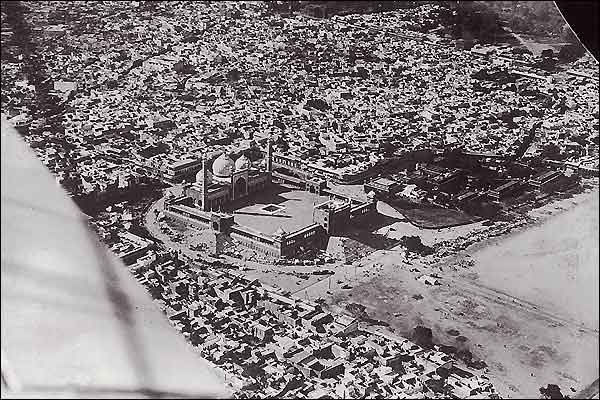
The following is an excerpt from H. K. Kaul’s Historic Delhi, An anthology published by Oxford University Press, 1985.

http://designscene.wordpress.com/2008/11/12/old-photos-of-india/
The city is known to be more than 3,000 years old. Around 1450 B.C. a forested area on the right bank of River Yamuna was chosen as the site of Indraprastha by a Pandava king mentioned in Mahabharata. It is said that, after the Indraprastha faded, a new city called Dilli was founded in 57 BC by Raja Delu of Kanauj. Dilli seems to have been a small city until Tomar Rajputs captured it in 736 AD.
In the tenth century the Tomar King, Suraj Pal, built a circular reservoir, and a temple south of the city, which is now a popular tourist destination known as Suraj Kund. Another addition to the city was made in 1060 AD by Tomar King Anangpal, the building is known as Lal Kot where also stands the Iron Pilar cast around 400 AD to commemorate the heroic deeds of Chandragupta.

Chuhans succeeded the Tomars and Rai Pithora, the celebrated Rajput king enlarged and fortified the Lal Kot building and called it Qila Rai Pithora. The fort has several rows of massive ramparts and some portions of it still stand. In 1192 Qutub-ud-din Aibak, a commander of Turkish ruler Shiahbuddin captured Delhi and a new era in the history of the city started which lasted for seven centuries.
Successive Muslim rulers continued to expand the city, in 1321, Tughlaq ruler, Ghiyas-ud-din added Tughlaqabad, five kilometers to east of existing Delhi and built a massive fort with 13 gates, it had underground passages connecting it to the old Delhi. Five years after the completion of the Tughlaqabad fort Ghiyas-ud-din’s son killed his father and abandoned the fort to move back to old Delhi. The famous traveler Ibn Batuta, who lived in Delhi for eight years during the region of Ghiays-ud-din’s son Sultan Muhammad Shah Tughlaq described the Sultan as eccentric who later abandoned Old Delhi and moved the court to Deccan.
In 1398, Timur Lame struck Delhi and more tha 50,000 of its citizens were looted and killed. Delhi shrank after that catastrophe and did not recover until Babur, a descendant of Timur defeated Ibrahim Lodhi and took Delhi for the Great Mughals. Mughal rulers were great builders and continue to add to Delhi. In 1639, Mughal emperor Shajahan built the Red Fort, the Palace, and the Jami Mosque. His daughters and wives continued to add gardens, bazaars and mosques to Delhi. The Mughal Dynasty had 19 kings, but with the death of Aurangzeb in 1707 the Mughal empire centered in Delhi began to decline.
On May 10, 1857, after a bloody revolt against British forces in India, British put an end to the Mughal Rule in Delhi . The last Mughal king Bahadur Shah, who was a poet of some renown was exiled to Rangoon Myanmar where he died in 1862. In 1913 the British decided to build New Delhi to the south of the old Delhi and the task was given to Edwin Lutyens. He laid out New Delhi along wide boulevards accommodating palatial residence of the Viceroy of India which is now President’s house, Parliament house and the famous war memorial India Gate. After the 1947 partition of India, Delhi became the capital of India now boasting a population of more than 20 million people.

Leave a Reply