
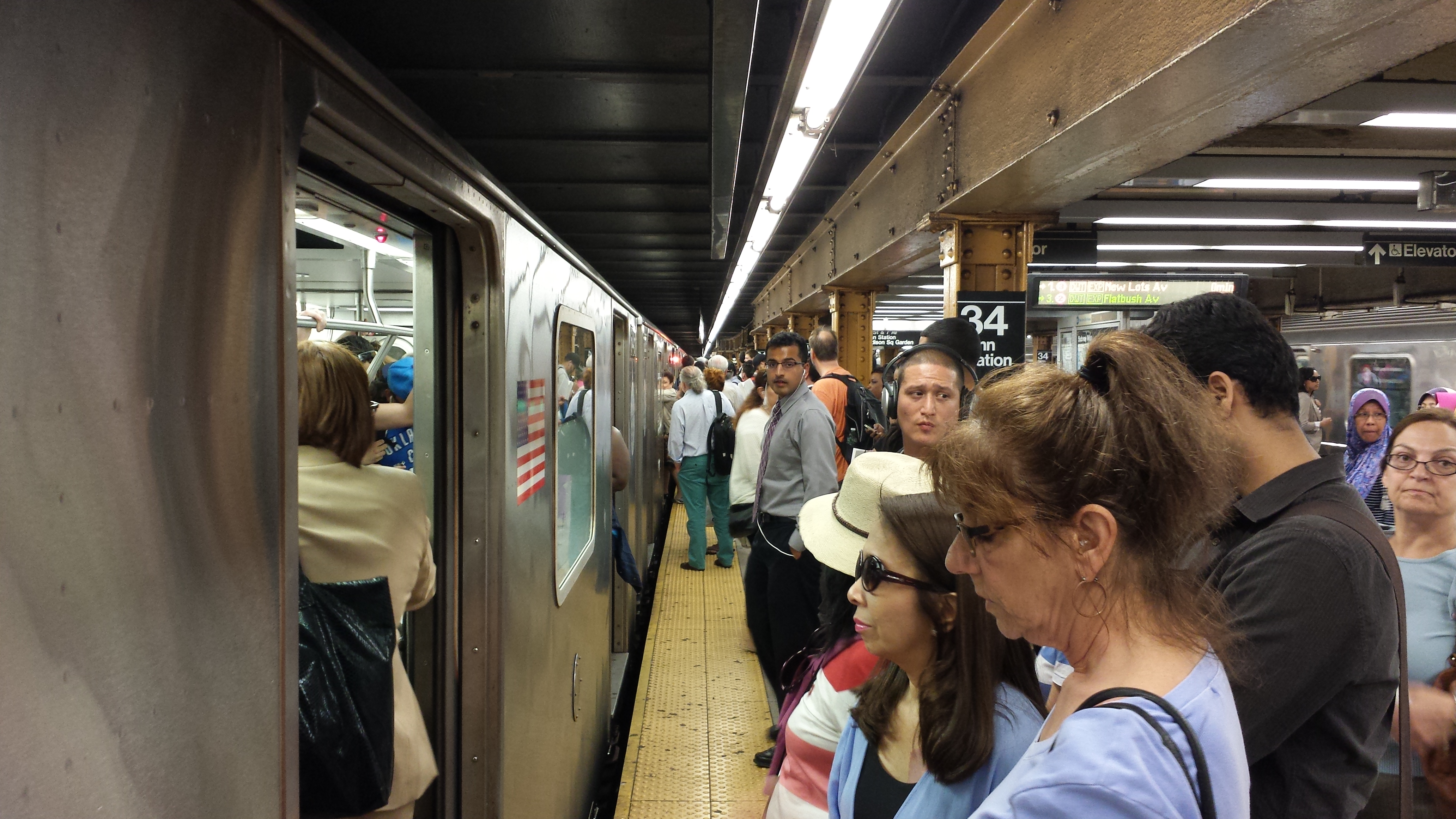
After waiting for three trains to enter and to leave Fulton Street before I could fit inside (there were delays), I had one more example to use when explaining why we need better public transportation. But what does better transportation mean? It depends on our geography, our culture, our economy, our politics, and our history.
Nevertheless, after being fortunate enough to spend a semester abroad studying urban planning in Europe, I’d like to share some of the “perks” of riding on their networks. Perhaps, some of these perks can be implemented here in the Big Apple and in other American cities. However, some of these perks probably cannot be implemented, such as honor systems used in some (but not all) Western European and Northern European countries, such as in Germany (Berlin), Austria (Vienna), Denmark (Copenhagen), and on the DLR in London (U.K.). Plainclothes officers randomly check for validated tickets on trains, and issue hefty fines to those who don’t pay. Plus, since arguably almost everyone pays in these places, the fines may even bring more revenue back to the agency than otherwise possible. While “proof-of-payment” honor system methods are used on the Hudson-Bergen Light Rail, and even on Select Bus Service routes, we have turnstiles whenever possible, including on our underground subway (and so does London, Paris, Amsterdam, Rome, Barcelona, Brussels, St. Petersburg, and Istanbul). Indeed, for better or worse, Berlin, Vienna, and Copenhagen historically tend to have relatively more collective trust and non-individualistic identities and ideologies when compared to New York and the U.S. (By the way, there are perks that we enjoy as well, which would not be implemented in many of these places, such as a 24/7 network). Proof-of-payment systems also depend on local conditions, including enforcement practices, institutional trust, fare policy, and expectations about compliance. These conditions vary significantly among cities, so a system that works well in Berlin or Vienna cannot necessarily be transferred directly to New York.
Before I get to the slideshow, I’d like to clarify that, of course, there are many plans for improving New York’s transportation network. So many people have dedicated their professional lives to the cause, and they’ve definitely accomplished a lot. The 2nd Avenue Subway is coming relatively soon, and so is the East Side LIRR Access project, the 7 Line Extension, Calatrava’s PATH hub, and the Fulton Center hub, which is definitely designed well except for the area above it (i.e., the MTA is definitely NOT taking advantage of real estate potential and the millions it could be receiving in additional revenue). These are some of the better publicized projects, but so much work is carried out every day, keeping the city running.
Moreover, plenty of other proposals have also been recycled through the years: one series of ideas promotes more peripheral lines that directly connect outer boroughs and provide for new business corridors; another series of ideas advocates for more regional routes, such as an LIRR connection from Atlantic Center to the Fulton Center, and then into New Jersey or Staten Island. And let’s not forget subway extensions into New Jersey, the light rail proposals for Staten Island and Bayonne, and countless other exciting and promising ideas. All roads (and rails) lead to Rome, and it’s the same in the NY Metropolitan Region, which has around as many people as there are in Australia. Indeed, all roads and rails lead to Manhattan, for better or worse.
But let’s fuggedaboutit for now, and focus on the perks of some of Europe’s transportation networks. While these systems have problems as well — and some could even learn a bit from the MTA — hopefully this article will help people to realize what we’re missing out on, and what we should be demanding in a (re)newed city.
There are three sections: the first, with efficiency examples; the second, with accessibility, convenience, and connectivity examples; and the third, with design examples. All perks come with a picture and a short description including the city.
Do you think some of these can be implemented in New York? Which ones would you like implemented sooner rather than later? Feel free to comment and discuss!
____________________________________________________________________________________
EFFICIENCY

Countdown clocks & smart card ticketing for automatic trains in Copenhagen, Denmark

Countdown clocks in Rome, Italy

Platform screen doors in Copenhagen, Denmark

Platform screen doors in St. Petersburg, Russia (The first in the world)

Automatic, efficient, punctual trains in Paris, France

Electric car sharing in Brussels, Belgium

Electric bus in Vienna, Austria

Smallest car (ever?) in Berlin, Germany

Bus lane in Barcelona, Spain

Part of an electric bus lane in St. Petersburg, Russia

Congestion pricing in London, United Kingdom

Universal Oyster card (i.e., one MetroCard for subways, commuter rails, etc) in London, U.K.

Universal payment system for ferries, trains, and trams in Istanbul, Turkey

Pre-board turnstiles for light rail in Istanbul, Turkey

Quick tapping (or, lining up to pay once all are fully inside tram) in Amsterdam, Netherlands

Europe-Asia Marmaray rail tunnel in Istanbul, Turkey

On-board honor system payment method (pay on machines inside tram) in Krakow, Poland

Pre-board payment method and honor system on trams in Bratislava, Slovakia

Individual doors open if needed (with green buttons) to save energy in Berlin, Germany

Biking traffic lights in Berlin, Germany

Deutsche Post delivery bike in Berlin, Germany
____________________________________________________________________________________
ACCESSIBILITY, CONVENIENCE, & CONNECTIVITY

Bike storage area and Wi-Fi location on commuter rail train in Copenhagen, Denmark

Bike, baggage, wheelchair, and baby carriage storage area on S-Bahn in Berlin, Germany

Bicycle rails to help people carry their bikes in Copenhagen, Denmark

Rails for bikes, strollers, and wheelchairs on subway staircase in St. Petersburg, Russia

Bike racks on a ferry in Berlin, Germany

Bicycle parking in Amsterdam, Netherlands

More bicycle parking in Amsterdam, Netherlands

Underground bicycle parking next to subway station in Copenhagen, Denmark

Raised bike lanes in Copenhagen, Denmark

More raised bike lanes in Copenhagen, Denmark

Bicycle parking spaces in Vienna, Austria

Bicycle sharing in London, United Kingdom

Disability pavement in Paris, France

Easy regional connections (commuter rail on left, subway on right) in Paris, France

Easy international connections (Eurostar to Paris) in London, United Kingdom

Easy local connections via walking and biking maps in London, United Kingdom

Re-opening of public space by removing highways in Barcelona, Spain

Smart underground parking network in Dresden, Germany

Above the underground parking (elevator entrance on left) in Dresden, Germany

Underground parking, bike lanes, and countdown clocks in Vienna, Austria

Pedestrian only zone in Bratislava, Slovakia

Bicycle parking laws in Malmo, Sweden
____________________________________________________________________________________
DESIGN

Beautiful stations in St. Petersburg, Russia

Tubes of light from above in Berlin, Germany

Placemaking U-Bahn stations in Berlin, Germany

Free electronic reading room in Orly airport in Paris, France

Free video games in Orly airport in Paris, France

Public park on former Tempelhof airport in Berlin, Germany

Biking along the Tiber River in Rome, Italy

Lit-up station for current location on map in Brussels, Belgium

Magazines to read in U-Bahn in Vienna, Austria

(Clean) emergency clearance area in St. Petersburg, Russia
____________________________________________________________________________________
I’m sure that a lot of these relatively “simple” fixes are already written about, and indeed, the MTA probably has a whole list of projects to work on. Countdown clocks may seem simple, for instance, but the MTA had to do a lot of work to install them for the IRT stations (and the L) that they’re installed. The agency first had to know exactly where these trains were in the tunnels. Also, platform screen doors sound simple enough, but trains have different lengths and widths (especially between A Division and B Division trains), and doors on one version may fit while others may not.
Nevertheless, in all seriousness, how long would it take to finishing adding cell service? Or to install bicycle rails so people don’t have to lift their bikes up stairs? Or make it easier for people to enter through turnstiles with their bikes? And how much money is involved in adding pavements for disabled people to be able to feel as they walk, so they can be safe in stations and find their way to elevators and train doors? Why haven’t these relatively simple fixes been completed? Is it because of a lack of funding? Poor leadership? Unions? Design regulations? American NIMBYism? Racism? Classism? A quintessentially American distrust of government? A culture of suing (and a lawsuit for tripping on a bike rail)? Or, lastly, bloated bureaucracies that refuse to streamline and unify themselves (i.e., the MTA’s countless sub-companies, NJT, and PANYNJ)? Feel free to comment below with your thoughts and with any ideas that you may have about how the MTA and the region should improve, and with any additional information!
In the end, there’s no doubt that the MTA has improved the subway quite a lot in the past few decades. It’s cleaner, it’s safer, it’s brighter, it’s (more) punctual, it’s easier to understand, and it’s being expanded. Many, many, many stations have been renovated, and infrastructure is constantly being repaired throughout the network, especially now with FASTRACK. There’s Wi-Fi, interactive help points, artwork, and placemaking in select stations, and the MTA is also upgrading infrastructure to prevent future flooding. Moreover, the MetroCard has been around for quite a while now, MTA Bus Time rocks, and Select Bus Service is a great program (with express service, pre-board payment, and *sometimes* bus lanes)… (However, SBS requires inconvenient slips in order to board with proof-of-payment, which take time to get on the sidewalk; indeed, a bus could easily be missed even if one already had MetroCard money, but didn’t yet have time to get a printed slip before the bus departed… It would be more convenient to have ample room inside the bus for people to line up to pay, once everyone is fully inside so the bus/tram can be moving, or tapping a future “smart” MetroCard… This is done in countless places, including Sao Paulo…).


L: Too many “Help Point” locations at Grand Army Plaza in wealthy Park Slope, BK? There are SIX in total: 2 devices on each side of one platform repeated 3 times on the platform… while many stations have none at all yet… these are definitely not going to be used much, especially if the MTA is also adding cell service everywhere… and this is definitely evidence of an unsustainable fiscal “gap” in (G)rand (A)rmy (P)laza…
R: New interactive screen coming soon to Jay Street…

Flood walls (post-Sandy) on IND Rockaway Line
These are just a few of the (usually helpful) things that the MTA has been doing to improve our massive (and old) system, which is undoubtedly the best in the U.S. and better than some systems in Europe in certain ways (i.e., frequency and extensiveness). But, the MTA still has a long way to go. Why is Europe generally better and greener than America with public transportation? That’s a long story for another time.

(Another delayed train with no more standing room… but, there’s a countdown clock on the platform, the train is relatively new, there’s tactile paving, there’s elevators, and the station is relatively clean!)

(There have been SO MANY delayed trains lately, but this one here went out of service entirely during rush hour)
Rayn Riel is a student at Tufts University studying international urban development, his self-crafted major. Interested in transportation, he is the founder of Tufts’ only undergraduate urban development student organization and was an intern at the NYC Department of City Planning in Brooklyn in order to work on transportation accessibility and mobility in East New York. A writer on PlanYourCity, he has had planning work and research experience in the Americas, Asia, Africa, and Europe, as well as in the United States.
(All photos are taken by Rayn)
Additional ‘soup’ of my photos in Europe…

Tempelhof Airport, Berlin

Rome Metro

Paris Metro

Arch de Triumph in Paris

Paris ‘Love Locks’

Montparnasse Train Station Joint Development in Paris

Paris Metro

Paris CBD

Paris Metro

Green Design in Malmo, Sweden

Copenhagen Bike Lanes

Fascist Protesters in Copenhagen

Copenhagen and Øresund Bridge

Copenhagen Central Station

Istanbul Metro

Istanbul Metro Station on Bridge

Istanbul Tram to Taksim Square

Historic RR Terminal in Asian Istanbul

Amsterdam Central Station

Vienna Trams

Vienna Metro

Shared Space in Bratislava, Slovakia

Bratislava Central Station

Communist Planning in St. Petersburg, Russia

St. Petersburg Trams

St. Petersburg Electric Bus

St. Petersburg Metro

St. Petersburg Metro

St. Petersburg

St. Petersburg Outskirts

The People’s Metro Station in St. Petersburg

Russian Intercity Train

St. Petersburg Intercity Train Terminal

Greenery in Barcelona

Barcelona

Barcelona Terminal

London DLR Value Capture

London

Bus Lane in London

Parliament Security at Tube Entrance

London Tube Congestion

King’s Cross and St. Pancras in London

London Double Decker Bus

Pedestrian Bridge in London

London Ferries

London Cable Car

Public Space in Brussels

Tram in Brussels


Leave a Reply