How do New Yorkers stay grounded? Perhaps through strolling in a park or exercising in a gym, or grabbing some sun at Coney Island. But the city itself is literally (under)grounded by public transportation. And we need to keep New York on track — also literally — in order for it to continue to prosper. Most New Yorkers understand this, and they’d be happy to see the Second Avenue Subway extended into Harlem, a Utica Avenue extension, or the Rockaway Branch utilized, or Triboro RX, Penn Access via the Hell Gate Bridge, and countless other initiatives that have been discussed for decades, completed, such as bicyclist bridges and greenways, more dedicated bus lanes, and universal smart cards (or simply using smart phones). But I’d say, Gothamites also understand that words mean nothing until action is taken. Most of these proposals will never get built, just as they never got built in the 1960s, during one of the city’s last big announcement frenzies: the Program for Action. But some ideas, hopefully, will get built. The low-hanging fruit should certainly be prioritized, such as creating subway orridors along existing defunct railroad ROWs, such as the Rockaway Branch; after all, the MTA did this for the IRT Dyre Avenue Line and the southern portion of the LIRR Rockaway Branch.
Abandoned LIRR passenger railroad to Sunnyside, Queens (RR)
.
In 1960, 3 billion people lived on Planet Earth, compared to 7 billion today, and by 2050, that’ll be 9 billion. More than half of the world’s population now lives in an urban area, and by 2050, two-thirds will be, thus increasing demands on the environment and our planet’s natural resources. (Until world population starts to decline, as in Europe and Japan). While New York’s population is not growing much compared with other American cities in the Sun Belt, or with cities in developing countries, subway ridership (and commuter rail ridership) has reached levels unseen in decades. And delays have been increasing, while capacity constraints become more and more evident. Open gangway subway cars will help, and so will CBTC. But with limited resources, what should be prioritized? Renovating stations and installing Wi-Fi? Countdown clocks? Renewing and enhancing existing infrastructure, or expanding the network?
WiFi (RR)
.
We are not as congested as Sao Paulo’s subway, or Caracas‘ subway, but we’re getting there.
And if we don’t keep expanding our mass transit system, or implement congestion pricing, we’ll also become more congested on our roads:
It’s also important to note that our system actually has fewer miles than in the 1950s, when the system last had as many people. Elevated railroads would literally rise above the congestion, and hundreds of companies invested in this technology in order to make it a reality in American cities. The Big Apple was the world capital of the 20th century arguably because no city could compete with its public-private partnership transportation network, steam network, water system, tube mail, so on and so forth (but, no alleys, which would have made it cleaner, bringing the garbage off of the main streets). The private, profitable trolleys and elevated railroads ruled the city, but today, it is hard to imagine that there used to be railroads connecting to the subway on Second Avenue, Third Avenue, and Ninth Avenue in Manhattan, which connected to the IRT in the Bronx and the New York, Westchester, and Boston Railway. Among the many defunct lines in Brooklyn: Fifth Avenue and Myrtle Avenue, as well as the Culver Line and the Prospect Park and Coney Island Railroad. Railroads connected the city where the track has now been sold for scrap or recycled into new projects.
The old elevated subways that once rumbled through the streets of America’s great industrial cities have, since the end of World War II, been slowly replaced by more modern subways in places like Chicago, Boston, and New York. Elevated lines fell out of fashion in the early part of the 20th Century due to the noise, dirt, and shadows they produced. These old relics of the Victorian era were once the cutting edge of technology and transportation but, like all technologies, were quickly replaced and deemed obsolete. Newer elevated subway systems built after the 1960s use concrete and resemble highway ramps rather than a spiderweb of steel and are less disruptive then their forefathers.
What I love about both movies is how we are the ones that have the connection to these structures. We use them everyday; they are a part of our lives. And just like us they have a life span which one day will end. They are just structures of steel and wood but they mean different things to different people. To the real estate developers they once meant a way to open up vast new lands for development but then switched to being a hindrance to growth. To the people living next to them they were either a nuisance that disturbed or a reliable form of entertainment. To the rider they were your way to work and home that provided a unique view of the city. While riding out to Astoria to see friends over the last 7 years I’ve always been transfixed by the ever changing skyline rolling past the window.
During the post-War years the old els were seen as a rusting relic and obstruction to progress. Much of the problem with els were that cities didn’t take care of them. As less intrusive transportation options opened up they were quickly demonized and were blamed as leading to many of the ills of the industrial city. No longer seen as modern, els in New York, Brooklyn, Boston, and Chicago were torn down and either replaced with subways or buses. New York ran gung-ho into tearing down its elevated lines as soon as the subway proved popular and later when the car took over. A number of lines still exist in Brooklyn, the Bronx and Queens but the Manhattan lines were demolished with nothing left to show for them (save a short section in Inwood). During World War II the Atlantic Ave el in Boston, which was shuttered due to low ridership in the 1930s, became scrap for the war effort.
What I find interesting is as time went on people began to warm up to these structures and began to question their demolition much like the historic preservation movement took off. These structures were as historic as any great mansion on 5th Ave in their own right. As noted in the documentary about the Orange Line, it was the first all electric elevated subway in the world (New York’s and Chicago’s elevated lines started out as steam) and many of the stations (much like today) were products of architectural competitions. Wipe away the decades of dirt and grime and you begin to understand how revolutionary and revered these structures were.
Chicago had an arguably more positive view for its elevated system and while certain lines were cut back and stations closed the city has kept it’s system in good working order. And as more and more people have begun to rediscover the city, and as old industrial cities have begun to clean up their image, these old relics have suddenly been rediscovered. Elevated train lines that once covered neighborhoods with smoke and shadow have lain unused for so long that nature has taken over and we see them as the opposite of what they once were. Once an industrial backbone of Manhattan’s West Side, the High Line connecting slaughter houses and warehouses the High Line has been rediscovered and reimagined as a world renowned park and has inspired cities with elevated rail lines from Chicago to Philadelphia to rethink these once maligned structures.
As automobiles became more accessible, highways were built, and just as railroads had spurred development outwards, highways, too, expanded the region and allowed for suburbanization. Americans could now live away from the congestion of the city, raising families away from the noise and pollution of industry. Land was cheaper, property taxes were cheaper, and open space enticed not only residential construction, but also industrial growth, with convenient parking and modern facilities. After all, building away from the urban core was simply easier; developers did not need to deal with NIMBYists, or with concerns about noise, light, and traffic, because it was an entirely newly developed area. Even warehouses and distribution centers moved towards the suburbs because land was cheaper, and locating along a railroad in dense multi-story buildings was no longer necessary. Package delivery services had become so efficient with trucks. As this process continued, it was catalyzed by the Great Migration of African-Americans to urban areas out of the Southern United States, and the resulting race riots and white flight from the inner city. Today, it is also easier for businesses to sprawl due to communication technology, such as broadband, e-mail, and video conferencing, reducing the need to conglomerate.
Today, most Americans live in the suburbs, rather than in cities or rural areas, and many don’t even work in the urban core, commuting to edge cities instead. In many American cities, suburbs continue to grow, while their core city remains stagnant or shrinks. But in some cities, inner cities are growing again, too, such as New York. Historically, it was believed that urban life caused social isolation, disorganization, and psychological problems, and that the lower density, lower crime, and more stable population of suburbs would be more conducive to happiness. But sprawl also caused these problems, by isolating people to their automobiles and televisions, because there are simply not many opportunities in the low-density neighborhood for interaction and casual encounters. Density allows for dynamism, the lifeblood of urbanity, and that does not exist in suburbs — especially for the children, elderly, and disabled, who cannot easily travel. (Then again, too much density can also lead to problems; dense high-rises can also lead to social isolation.)
Jane Jacobs, legendary urbanist, fought Robert Moses’ highways, which were plowing through neighborhoods, and tearing down the dense, urban fabric, creating windswept top-down neighborhoods. Similar projects were being carried out throughout the world at the time, such as the planned city of Brasilia, which looks fine from the sky, but is far too hard to traverse as a pedestrian, on the ground. And in Jane Jacobs‘ dense neighborhood of Greenwich Village, transit was the lifeblood.
Greenwich Village Bike Lane (RR)Greenwich Village (RR)
.
The young are now flocking back to post-industrial cities, which are cleaner and safer than they’ve been in decades, where many may stay even after having children, if they can find a good school. And they are finding public transit networks that are not sufficient. But they do not understand why, and, unfortunately, it appears as though many of their leaders don’t know, either.
The MTA needs a narrative, so that people can understand why delays are increasing, beyond the daily headlines. The MTA needs more efficient and effective communication; it needs constructive communication, and, again, I also mean this literally. Countdown clocks can’t simply be constructed, for instance, without knowing when trains will arrive, which can’t happen when the MTA doesn’t know whereB Division trains are located. The MTA’s physical communication system isn’t just outdated when it comes to station platform PA networks.
When New York’s signaling system was first being installed—much of the work took place at the turn of the last century, with another big wave during the FDR-fueled construction boom of the 1930s—the designers wanted to make it impossible for there to be a collision. They wanted intelligent signals: signals where even if you made a mistake, even if you wanted to, you couldn’t command two trains to simultaneously drive into the same section of track.
This becomes especially important when you have tracks that cross, and switches that route trains from one track to another. In a subway system this happens all the time. New York’s is especially hairy, since many lines have both an express and local track going in each direction. Some big stations can have as many as a dozen lines connecting.
The way you do it is by having what’s called an “interlocking.” An interlocking is just a configuration of signals, switches, and their controls that is set up in such a way that you can never have an unsafe state. In the early days, this was enforced by levers that literally interlocked. If you want to flip a switch over here, you first have to make the signals over there red. If a train entered this section over there, the switch over here would always be disabled. Before semiconductors and the modern microprocessor, these systems represented our best attempt to mechanize complexity.
To design even a single interlocking was, and still is, terrifically complicated. A thousand considerations—the interactions between signals, switches, and trains; the curves, grades, and other track conditions that affect train speed and braking distances—go into their design.
A 1968 plan for a small section of New York’s trackage and interlocking, showing the placement of signals and the part of the track whose safety each signal controls. (nycsubway.org)
The switches are connected by wire or still, in some cases, by actual levers, to rooms called “towers” where operators can see which sections of track are occupied, what color the signals are, and what the state of each switch is. By pulling levers and talking to drivers over the radio, they clear paths for trains. The interlockings ensure that even if they do something wrong, they can never clear two trains to take the same path.
The reason there are no realtime countdown clocks on the F line is that even the tower operators don’t know which train is where. All they can see is that a certain section is occupied by a certain anonymous hunk of steel. It’s anonymous because no one has a view of the whole system. A hunk comes into one section of track from somewhere else; the tower’s job is to get it through their section efficiently. The next tower they pass it to will likewise not know whether it’s an F, say, or a G. When there are incidents, trains are located by deduction.
This complex—of towers, signals, switches, and track sections—is responsible for a disproportionate share of the costs and foibles in the operation and maintenance of New York’s subway system.
The equipment is old and breaks all the time. In fact it’s so old that the MTA can no longer buy replacement parts from the manufacturer; it has to refurbish them itself. Some of the controls for the interlockings are originals from the 30s. Much of the wiring is still insulated with cloth, instead of rubber; ten years ago the entire Chambers Street interlocking caught fire. Salt water from Hurricane Sandy did damage to trackside switches and signals that is still being repaired.
In all there are more than 12,000 signals and 300,000 relays that comprise the system’s interlockings. Signal failure is the largest source of delays in the subway. There is an incident on average every 11 hours. Whenever a signal fails, the ones behind it go red, since they can’t be sure there isn’t a train in that section. Often, a can or a piece of aluminum foil is enough to fool a track circuit.
For decades, New York had little interest in modern signaling technology. It was happy just to keep the trains running. The MTA was biased in favor of brick-and-mortar work. The attitude was that if you weren’t building a new station or track, it probably didn’t need to be done.
Then they got a wake-up call. Just after midnight on August 28, 1991, a 4 train running downtown with more than 200 passengers derailed at a switch just short of Union Square. Five people died. So many support columns were destroyed that the street above the station sunk by half an inch. The driver had been drinking heavily the day before the accident and was asleep as the train approached the station. They were traveling at 50 miles per hour, five times the normal speed.
A train stop on the tracks triggered the emergency brakes but it turned out to be too little too late. The signals had been spaced too closely; there wasn’t enough track to slow the train. It was a sobering moment. The foundations of the system—track circuits, signals, train stops—were cast into doubt. By 1994 the MTA was presenting a business case for a new kind of signaling system that had become the standard for modern transit projects: communications-based train control, or CBTC.
CBTC does away with the “fixed-block” signaling system, where track is broken into sections that report whether they’re occupied. Instead, each train is equipped with a radio and onboard computer that identifies its precise location, and coordinates that information in real time with a central control center and other trains to decide exactly how fast it can safely go. Trains therefore run with a moving window around them, which constantly shifts depending on their own speed, size, track conditions, and traffic.
The big benefit is that this allows you to run trains closer together. And you can use the track more flexibly. For example, in many fixed-block signaling systems, including New York’s, the signals along certain sections are only set up for trains to go in one direction. But CBTC just sees a bunch of track; it can automatically figure out which parts of it are available, say, for turning trains around.
A diagram of a moving-block signaling system powered by CBTC (Regional Plan Association)
In fact, with CBTC, you no longer even need signals or interlockings. If you were willing to go all-in, you could completely remove all your old levers, relays, track circuits, and signal towers. Safety would instead be guaranteed by the fact that the system as a whole knows about every train and can control its speed. If there were ever a communications failure, failsafe equipment on each train could instantly trigger the emergency brakes.
The only equipment required are trackside controllers—computers with radios, basically—spaced at regular intervals; train controllers installed on each train; and a central control center. Unlike the old relays, all the trackside equipment is completely enclosed and can withstand decades of wear and even saltwater.
Maintenance costs would plummet. The bulk of the system’s complexity is moved into software: software that interfaces with the physical train controls; software that understands the entire system’s track layout, including all switches, grades, and stations; and software with a huge number of rules about what kind of movements are allowed when.
Since CBTC requires realtime location data to operate, relatively little additional work is required to give that data to customers, say in the form of a smartphone app that reports arrival times or in countdown clocks hung at stations.
The Canarsie Line running from 8th Avenue in Manhattan to the Canarsie neighborhood in southeast Brooklyn was chosen to pilot the technology. It was one of the oldest lines in New York, starting life as a steam railroad in the early 1900s, but seemed ideal as a test case: It was completely isolated from the rest of the system, with just one line, the L, running along it; it was shorter than most other lines; and it had relatively low rider volume.
Work began in 1999. It wouldn’t be fully operational until 2011. At the current pace of installation, the subway system as a whole won’t be converted to CBTC for another 175 years. It will cost $20 billion.
“You try to benchmark New York to other places and you can’t,” says Richard Barone, the director of the RPA’s Transportation Programs. Everything is harder here. Everything takes longer here. He explained that the Canarsie pilot suffered from problems that weren’t unusual for big transit projects in New York.
The first was outmoded work rules. CBTC is designed so that trains can run themselves. But the L still has two-person crews on board every train. They’re not very busy: An April 2007 article titled “Look, Ma—no hands!” in the trade magazine Railway Age featured a delighted train supervisor named Lance Parrish riding in a CBTC-equipped train on the Canarsie Line. “All Parrish has to do is scan the onboard displays and acknowledge a flashing/beeping alerter every 20 seconds.”
The second was a fear of change. It costs $168,000 per track-mile per year to maintain trackside signals, 90 percent of which is spent on labor—much of it done overnight and on weekends, qualifying the workers for overtime. If those signals were eliminated, millions of dollars could be saved each year. But New York decided to run CBTC on top of a reduced form of the old fixed-block signaling system, requiring that both be expensively maintained, despite evidence from other cities that no backup was necessary. (In Vancouver, the SkyTrain has had no CBTC-related accidents in more than 26 years.) And the fact that the two systems had to work together—requiring the supplier to study the old signals in depth—became a major source of delays.
Barone says New York just wasn’t willing to rip the band-aid off. Cities like London deal with major transit upgrades by packing maintenance and line closures into as short a window as possible, however painful that might seem at the time. New York, by contrast, draws out its track maintenance. All that waiting isn’t free. These are huge projects for contractors; they’ll spin up a whole office, a whole mini workforce, just to work on it. And when they’re waiting for track time, that workforce doesn’t just spin down—it continues to get paid. Anticipating delays, contractors inflate their bids.
All told, CBTC enabled a 3 percent decrease in end-to-end travel time on the L, and the MTA claims that it has increased capacity from 12 to 15 trains per hour in the late ‘90s to 20 trains per hour today. (It’s not clear that CBTC is responsible for this change. In 1999, the Williamsburg Bridge was closed temporarily, and the MTA managed to increase service on the L to 20 trains per hour to make up for lost capacity on the J, M, and Z lines.)
The project took 11 years to become fully operational and cost $340 million. The next steps for CBTC are the Flushing line, which is already underway, and the Queens Boulevard line, where the contract was just awarded. It is shaping up to be a more capital-intensive and longer-running project than the first leg of the Second Avenue subway, and almost as big as Boston’s Big Dig.
But compared to those projects it is awfully nebulous. It’s hard to explain an underground-systems upgrade to customers; and it’s hard for customers to notice, especially if the city keeps maintaining the old signal systems and neutralizing its own cost savings.
That’s why the MTA has tried to associate CBTC with countdown clocks. It’s a misleading narrative. You can get countdown clocks without touching the signals. The MTA knows this. They learned the hard way that tying countdown clocks to a massive CBTC-esque signal upgrade is a mistake. That’s what happened with the 1-6 lines: The project, called ATS, cost $220 million and took 5 years longer than it was supposed to. To deliver countdown clocks to the rest of the lines by 2017, they intentionally developed a simpler plan. The whole point of it was to avoid trackside signal upgrades.
If they’re being realistic, it’s that project, not CBTC, that the MTA should be talking about when it talks about clocks. The thing is, it’s kind of awkward to talk about. That project is to ATS as ATS was to CBTC: a lesser, overlapping, incompatible and possibly unnecessary stopgap. One of three redundant initiatives started at different times for different reasons, by an agency clumsily trying to rewire itself.
The story of how it could take 28 years to install clocks that tell you when the damn trains are coming turns out not to be about some dinosaur fixed-block signaling system and the gleaming new technology here to replace it. It’s simpler than that: It’s the story of a large organization’s first encounter with a large software project.
In the mid-90s, the MTA decided to make major upgrades to the older of these two systems, the A division, devising a $200 million plan to repair old signals, convert mechanical interlockings to use electronic relays, digitize the interlocking data, pipe that data into a central control center, use it to activate switches remotely and reroute trains, and distribute arrival information in real time to countdown clocks installed in every station on the 1-6. It would be a massive consolidation of what had been disparate systems. It was going to require serious technical expertise: not just to install the new gear, but to retrofit and interface with the existing interlockings. The project was called “ATS,” for Automatic Train Supervision.
If it sounds similar to CBTC, that’s because in all respects the goals are the same, except that ATS stops short of allowing remote control of trains. Both approaches consolidate location data that had been distributed and use it to build a picture of the system as a whole, allowing operators to put a name to each train and therefore to make better decisions about how to route them. But CBTC, when implemented as designed, is by far the simpler way to do this, since it obviates signal towers and interlockings altogether.
Given that CBTC would—and will, someday—accomplish the same thing as ATS; and given that it could be done much more efficiently; it makes you wonder how ATS got started in the first place. The answer is that planning for ATS began in 1992, two years before the MTA started seriously considering CBTC as an option. Had ATS been started two years later, it might have never been started at all.
The project was in many ways a success: It brought old signals into a state of good repair, it created a (very cool-looking) centralized Rail Control Center, and it delivered countdown clocks to the 1-6 lines. But all of that was supposed to take nine years; it took 14 instead. ATS is now remembered as a classic case of mismanagement.
A post-mortem by the Federal Highway Administration details how from the start, an agency which had had little experience with large “systems” projects tried to wing it. For instance, the consulting firm tasked with developing the project plan never made a list of requirements, didn’t talk to the workers who would be maintaining the system until after it was designed, and left vague instructions for large chunks of work—specifying, for instance, “similar functionality to what is currently available”—that later became the focus of drawn-out contract disputes.
The MTA thought that they could buy a software solution more or less off the shelf, when in fact the city’s vast signaling system demanded careful dissection and reams of custom code. But the two sides didn’t work together. The MTA thought the contractor should have the technical expertise to figure it out on their own. They didn’t. The contractor’s signal engineer gave their software developers a one-size-fits-all description of New York’s interlockings, and the software they wrote on the basis of that description—lacking, as it did, essential details about each interlocking—didn’t work.
Gaffes like this weren’t caught early in part because the MTA “remained unconvinced of the usefulness of what seemed to them an endless review process in the early requirements and design stages. They had the perception that this activity was holding up their job.” They avoided visiting the contractor’s office, which, to make things worse, was overseas. In all, they made one trip. “MTA did not feel it was necessary to closely monitor and audit the contractor’s software-development progress.”
The list goes on: Software prototypes were reviewed exclusively in PowerPoint, leading to interfaces that were hard to use. Instead of bringing on outside experts to oversee construction, the MTA tried to use its own people, who didn’t know how to work with the new equipment. Testing schedules kept falling apart, causing delays. The training documentation provided by the contractor was so vague as to be unusable.
You get the impression that the two groups simply didn’t respect each other. Instead of collaborating, they lobbed work over a wall. The hope on each side, one gathers, was that the other side would figure it out. Miraculously, they finished. It took nearly twice as long as they thought it would. After everything, after more than a decade, they were left with a system that isn’t even compatible with CBTC. And they were still less than halfway done.
Clearly, more effective and efficient, ‘constructive’ communication and cooperation is necessary. Transportation is not only about moving trains, but about communication, and even within the MTA, there’s ample miscommunication. So how can we expect the MTA to be able to coordinate with the Port Authority, or New Jersey Transit, or the DOT? Or with the public?
What could we get with better communication? Perhaps, we could include PATH on the subway map as a rapid transit route? Or, physically unify the PATH with New York City Transit? (Which could be complicated by the fact that the PATH is a railroad under the jurisdiction of the Federal Railroad Administration. It used to share trackage with Pennsylvania Railroad in the section between Hudson interlocking near Harrison and Journal Square, so historically, it needed to adopt to federal railroad safety requirements).
After all, PATH is New York’s second subway system, and it is a good example of regional cooperation, operating in two states, and five municipalities (New York, Harrison, Hoboken, Jersey City, and Newark). It carries more than the entire public transit systems in Atlanta, Los Angeles, or Miami, and it accepts MetroCard, and operates 24/7. Courtesy of Subway NY/NJ:
PATH is Incorrectly Represented – PATH is a rapid-transit system. It operates 24/7, provides frequent service with short headways (time between trains), accepts the same pay-per-ride MetroCard as the Subway for fare payment, and has six underground stations in Manhattan (four with direct physical connections to the New York City Subway). The current fleet of PATH train cars (PA5) are an updated version of the Subway cars (R142A) used on the 4 and 6 trains. However, PATH is represented on the Subway Map using the visual style labeled “Commuter rail service” in the map’s key: pale blue “railroad track” lines, square station markers, and small, lightweight text labels. This appears to be an incorrect application of the MTA visual style guide, and doesn’t effectively communicate to Subway riders that PATH is also a rapid-transit service.
Hudson Waterfront is Missing – PATH connects New York and New Jersey, but the Hudson Waterfront and stations across the river from Manhattan are missing from the current Subway Map, so Subway riders who want to connect to PATH to reach destinations in New Jersey currently see no information about where PATH can take them.
The future of Penn Station has long been an object of fascination for New Yorkers and others in the region. But what if that fixation on the terminal is misplaced? As transit blogger Yonah Freemark wrote this week:
“But what if this orientation towards rail terminals is actually reducing the effectiveness of our rail system? What if we eliminated terminals downtown altogether and just replaced them with regular old stops on the line, leaving terminals for outer suburban places?”
Imagine taking a commuter train from New Haven to Trenton, or from the boardwalk in New Jersey to the shores of Long Island Sound in Port Washington, without changing trains or even seats. That kind of easy, fast access to regional destinations could be the future of the tri-state area’s rail network.
That doesn’t happen if the region’s transit agencies and elected leaders can’t re-imagine Penn Station not as a terminal, but as one stop among several on a rail line through the city.
As Freemark documents, many European cities have rebuilt their formerly stub-ended terminals into stations on a through-running network. The approach has generally found less favor on this side of the Atlantic. Only Philadelphia has succeeded in building the connective infrastructure that makes through-running possible, although the tunnel has never been optimally used as the core of a true rapid transit system. Los Angeles will soon become the second American city to retrofit its commuter system for through-running, and in Canada, Toronto is transforming its Metrolinx network into a Paris-inspired rapid transit system with frequent service that may eventually allow for through-running at Toronto Union Station.
Indeed, implementing through-running at central terminals is typically only one part of a broader approach known as “regional rail” (as opposed to “commuter rail”). This approach focuses on frequent service around the clock (or at least late into the night), rather than focusing on weekday rush hours. This kind of service is especially important with reverse commuting and off-peak travel on the rise.
“The benefits wouldn’t just accrue to people traveling to special events, or to the odd souls who have regular occasion to travel straight from New Brunswick to Rye. Cohesive regional transit would be of significant benefit to the New York area, and to most everyone who depends on public transportation to get around it. The effect would be particularly noticeable to anyone who ever travels, in any direction, through Penn Station.”
Despite the clear benefits, any ambitious regional rail scheme that might be implemented in the tri-state region represents a major paradigm shift on both the operating and infrastructure sides, and as such remains years if not decades off. However, the core improvement—through-running at Penn Station—remains both eminently achievable and potentially quite beneficial for travelers. Part II of this post will explore short- and medium- term strategies for utilizing and implementing a through-running model at Penn Station.
Unlike Philadelphia, which had to build a tunnel between rail terminals in order to start through-running, and unlike Boston, which would have to do the same with the North-South Rail Link, New York already has the tunnel for through-running. Indeed, Boston may end up expanding their 19th century rail terminals, rather than connecting them, so that capacity can be increased. But Amtrak would help pay for a rail link, since it would extend the Northeast Corridor into Maine. It would bring in more passengers and get more vehicles off the roads, and even though Boston’s commuter rail network is not electrified, they could switch to diesel-electric locomotives, akin to how some of the Metro-North Hudson Line trains, which service areas past the electrified portion of the route, enter Grand Central.
The problem in New York is not physical; it is political. Pennsylvania Railroad had no problem building beyond boundaries, but today’s state authorities certainly don’t want to share power across political lines. If the region had remained whole as New Netherland, before the British arrived in order to divide and rule, splitting the region artificially along the Hudson River, then perhaps, through-running would be easier today. Regardless, MNR pays NJT to operate West of Hudson services, and ConnDOT also has many contracts with MNR for Connecticut service, so there are precedents of cooperation.
We need to connect the disconnects, and frame and create a narrative for the 21st century. Use data to visualize problems and bridge the gap between divisions, departments, communities, municipalities, and labor unions. NYC (and the region) need more of an interdisciplinary, team-based approach to solving problems, updating data, streamlining approaches, connecting institutions and stakeholders. Someone has to do the grunt work, succinctly. And clean the stations.
This should not be acceptable in New York City (RR)
But how can we get New York and New Jersey to cooperate? Governor Cuomo believes that the Hudson Tubes (to Penn) are “not [his] tunnel“, and Mayor De Blasio wants to build a light rail, not connected to the MTA, in order to, perhaps, not deal with Albany. Perhaps the City could be spending its limited time with a Utica Avenue extension, or the Triboro RX, or the Queensway, or a LGA connection, rather than the BQX, which would not even be connected with the existing network? But politics interferes and muddles priorities that could be based upon factual indicators — ridership projections, accessibility gaps — and turns priorities into re-election calculators.
Tunnels from Penn Station to NJ (RR)
.
The BQX is a glorified bus, and if it does not even have its own enforced lane, signal priority, and pre-board payment, and if it does not accept MetroCard, then it will be a complete waste of time. It would be cheaper to create true bus rapid transit throughout the city, rather than focus on one light rail corridor, in order to alleviate subway congestion with frequent and reliable buses. But this requires coordination and cooperation between the MTA, DOT, DCP, NYPD, and so on and so forth; Cuomo and De Blasio aren’t exactly willing to share power or information, and if De Blasio can build a light rail without the MTA, he won’t need the Governor. But he also won’t build an integrated network. Subsidized ferries are also a good step, and hopefully, since they’re a P3, the private operator will be more cost-effective and efficient. After all, if they’re not good, they’ll be replaced by another contractor.
Thus, Donald Trump is not the only one wishing to build walls. Throughout America, we have been dividing ourselves socially, economically, politically, and physically. Driving alone, living alone, eating alone, alone, alone. Today’s antagonism needs to be turned into a force for change, not channeled into divisiveness.
In Europe, high-speed rail not only connects within individual countries, but throughout multiple countries. Granted, individual countries are the size of U.S. states, but there is no excuse for no regional high-speed rail in the Northeast Corridor, for instance. I have been fortunate to study transportation abroad in 30+ countries, circumnavigating the globe, twice, and thus I know that we have a lot of work in order to renew and enhance our cities, and plan beyond divisions and departments, in order to transform transportation into the 21st century.
Virtually every wealthy nation in the world has invested in a high-speed rail network—with the striking exception of the United States. From Japan to France, even from Turkey to Russia, trains travel through the country at speeds of 150 miles per hour or above, linking city centers and providing a desirable alternative to both air and automobile travel. Meanwhile, outside Amtrak’s 28 miles of 150-m.p.h. track in rural Massachusetts and Rhode Island, the American rail network is largely limited to speeds of 110 m.p.h. or less. There are few reasons to think the situation will change much in the coming decades.
So why has the United States failed to fund and construct high-speed rail?
The problem is not political process. Most of the countries that have built high-speed rail are democratic, and have submitted the projects to citizen review; others, like Germany and Russia, have federated governments similar to ours that divide general decision-making between levels of authority. Nor is it geography. The British and French completed a 31-mile tunnel under the British Channel 20 years ago, while many American cities are located in flat regions with few physical construction obstacles. Nor is it the characteristics of our urban areas. While U.S. cities are less dense than those of many other countries, the Northeast is denser, more transit reliant, and more populated than most areas served by high-speed rail abroad. Nor still is it money. Though the United States invests less in infrastructure than other developed countries do, America nevertheless remains an immensely wealthy nation perfectly capable of spending on new rail links if desired.
What’s missing is a federal commitment to a well-funded national rail plan. Instead, we have a political system in which the federal government, having devolved virtually all decision-making power to states, cannot prioritize one project over another in the national interest. We have a funding system that encourages study after study of unfundable or unbuildable projects in places that refuse to commit their own resources. And we have a bureaucracy that, having never operated or constructed modern intercity rail, doesn’t understand what it takes. This helter-skelter approach to transportation improvements is fundamentally incapable of supporting large-expenditure, long-range projects like high-speed rail.
This wasn’t always the case. In 1956, Congress approved a significant increase in the federal gas tax, and with it a national plan for interstate highways. That plan, which included a steady stream of funding and a clear map of national priorities, was mostly completed over the next three decades. Though implemented by states, highway alignments were chosen at the national level, with the intention of connecting the largest cities, regardless of political boundaries. Funding came almost entirely (90 percent) from the national government and was guaranteed as long as a route was on the national map. Physical requirements for roadways were mandated at the national level and universally applied. And construction was completed by state departments of transportation that were technically knowledgeable, accustomed to building such public works, and able to make decisions about how to move forward.
The result was a system of roadways that most Americans rely on, often daily. The interstate system is unquestionably the nation’s transportation lifeblood.
Yet Americans do not have the same perspective on the role of the federal government that they had when this highway system was initially funded. Trust in Washington has declined from more than 70 percent during the 1950s to less than 20 percent today. So while President Dwight Eisenhower declared in 1955 that the federal government should “assume principal responsibility” for the highway system, its approach to a high-speed rail network has reflected this change in public thinking about Washington’s place in transportation planning. The response has been to reduce the federal government’s ability to commit to a long-term plan and associated funding.
Recent efforts to revive this federal role have been seriously flawed. Take the Obama administration’s attempt at a national plan of proposed intercity rail investments in 2009.
For starters, the map’s proposed routes were vague, a number of important connections were not identified, and some routes appeared to have been chosen at random—simply the consequence of previous state studies with no national outlook. Funding had been dedicated through an initial $8 billion included in the stimulus bill, but there was certainly no guarantee that railways on that map would be built in the long term. The definition of “high-speed rail” was not applied universally; the administration proposed some links at 90 m.p.h. and others at more than 250 m.p.h., with no explanation for why some would be fast and others not. Finally, many of the states that were supposed to be implementing these projects were woefully unprepared for the task, having made few such investments in the past. None had the experience of building 200 m.p.h. electric railways to the international standard.
Such an approach to national transportation doesn’t work. It leaves too many planning questions open to state decision making, and it fails to offer a financing source that actually produces the funds needed for intercity rail. Far from fulfilling Eisenhower’s mandate of assuming principal responsibility, the latest high-speed rail plan assumed too little.
But the need is still there. With falling automobile vehicle miles traveled, rising transit use, and booming city centers, we need new ways to connect our cities. More highways are not the answer, not only because they pollute the environment and destroy the neighborhoods they pass through, but also because they’re relatively slow and become congested almost as soon as they’re built. With a growing population, the country needs an expanded transportation system. The United States must invest in clean, neighborhood-building, and congestion-relieving trains, but we cannot expect states to pick up the slack of an uncertain federal government.
The planning and funding of the interstate highway system was premised on the fact that the travel needs of Americans occur irrespective of state lines. Indeed, the 50 largest metropolitan areas, representing more than half of the country’s population, are located in 31 separate states and 15 of them actually straddle state borders. Given this reality, it would be ridiculous to plan an intercity transportation system at the state level. California’s high-speed rail progress—its proposed San Francisco-to-Los Angeles line remains the only truly fast train project in the country—is the exception that proves the rule; that state’s size makes it no example for the rest of the nation.
It’s time for the United States to commit to national planning, funding, coordination, and prioritization of rail investment. Intercity transportation systems require active federal engagement to guarantee the development of routes that reflect national needs and national priorities. Yet without political consensus on the need to develop national goals and focus investments, high-speed rail will remain a pipe-dream for decades to come.
But again, what are our priorities? Should we be building more when basic maintenance for existing structures is hugely underfunded? When we can’t even compromise on funding maintenance, and when we don’t even have a stable source of funding from Albany? When Governor Cuomo allows the MTA to borrow more debt than the State of New York is allowed to borrow?
We are in serious trouble, with rising debt and rising inflation. Lying politicians control our transit priorities, and since most people aren’t knowledgable enough about our needs, they’re wooed by big, shiny legacy projects, such as the new PATH hub, which does nothing to improve capacity. There are ample cheaper fixes that would do much to improve our system, but politicians simply don’t care. Hillary Clinton doesn’t know how to swipe her MetroCard (and the reader needs to be cleaned), and Bernie Sanders still thinks that the subway takes tokens. They have broken promises, and we have broken rails.
Do politicians not care because we don’t care? Because as a society, we’re too focused on garbage media, and plastic consumerism? People used to return bottles to stores, for them to send back to plants to be washed, sterilized, and refilled. They dried clothes on a line using wind and solar power, or drank from a fountain instead of a plastic bottle. They refilled writing pens with ink instead of buying new ones, replaced razor blades instead of throwing away the entire razor, and cleaned diapers. Most walked or took streetcars in cities. Now, we’re wasteful, reckless, entitled, too easily distracted from the truth.
Here’s the truth: our transportation projects tend to cost a lot more than projects in peer countries due to “labor costs, work rules, managerial incompetence, and a political firmament without incentive to tackle hard issues”, and developing countries are able to build a lot more for less because labor is a lot less expensive, and many regulations protecting the environment, public health, and public safety are non-existent.
Select Bus Service is a lot cheaper than building a subway, and it can be almost as fast, if bus lanes are enforced, signal priority is effective, and proof-of-payment is practiced, to speed up boarding.
.
This is a rather unique problem, due to the fact that we are a federal country, founded on the spirit of individualism, and on the belief that government must be limited, and taxes must be limited, or else it’ll become as tyrannical as the British Empire. In order for America’s colonies to agree to be governed by a united government, the U.S. Constitution granted most power to state governments, so that colonists were not trading a tyrant across the pond with a tyrant next door. State governments, in turn, have granted tremendous power to balkanized municipalities. So, our institutional disconnects, and lack of cooperation, arguably stem from 1776. While pundits may argue that transit agencies need to be entirely reformed, that their motives are entirely perverse, the problem is even deeper than that: the U.S. Constitution encourages institutional disconnects, through a separation of powers, and through states’ rights. Americans do not respect power; they resent it, and they’ll never let go of their guns, their local town meetings, or their NIMBYist inclinations.
Now, of course, this is supposed to be a good thing, enabling citizens to communicate, cooperate, and compromise on policies and plans. The problem is that we’ve become so polarized that for the first time in modern history, Congress has refused to hold a hearing on the president’s budget. Disconnects cause us to spend more time and more money, raising costs to the sky, rather than buildings to the sky.
Why has it gotten this bad? Humorously, through our urban planning!
Over the past 40 years, Americans have been sorting themselves into communities where people increasingly live, think, and vote like their neighbors. In 1976, for example, just more than a quarter of Americans resided in counties where presidential candidates won the election by a margin of 20 percent or more; but by the year 2004, nearly half of Americans lived in these more politically homogeneous counties. [The concept of a blue state and a red state didn’t always exist].
The dynamics that fuel the Big Sort accelerated in the second half of the 20th century, coinciding with a massive increase in education. Between 1960 and 2008, for instance, the proportion of women with bachelor’s degrees nearly quintupled. The dramatic rise in educational attainment has a couple of unexpected side effects. For one, research shows that higher education has a polarizing effect on people: Highly educated liberals become more liberal, while highly educated conservatives grow more conservative. Second, people with college degrees enjoy greater freedoms, including social and geographic mobility. During the 1980s and 1990s, 45 percent of college-educated Americans moved to a new state within five years of graduation, compared with only 19 percent of their counterparts who had only a high-school diploma.
Meanwhile, evolutionary forces are pulling these more mobile, like-minded individuals together, because our political orientations play a key role in our choice of a mate. In society as a whole, spouses tend to resemble one another—at least a bit more than they would if coupling occurred at random—on most biometric and social traits. These traits include everything from skin color to earlobe size to income to major personality dimensions like Extraversion. Most of these statistical relationships are quite weak. But one of the strongest of all correlations between spouses by far is between their political orientations (0.65, to be precise). Spouses tend to have similar attitudes on moral issues like school prayer and abortion not because they converge over time, but rather because “birds of a feather flock together.” Biologists call this assortative mating.
Thus, President Obama has realized that, according to the Brookings Institution, “real progress can occur only if the federal government empowers local actors, and that spurring cross-sector collaboration on the ground is essential in confronting our toughest challenges”. Courtesy of President Obama:
Too often in the past, the Federal Government has taken a ‘one-size-fits-all’ approach to working with local communities, ignoring the unique challenges and resources of each place. Such an approach fails to fully leverage local knowledge and leadership in maximizing the impact of Federal resources and Federal-local collaboration. Addressing entrenched poverty or improving resilience in the face of climate change requires cross-sector solutions that bring together different agencies and different assets from local, State, Federal, public and private stakeholders.
From day one, the President called on the Federal Government to disrupt this outdated, top-down approach, and to think creatively about how to make our efforts more user-friendly and responsive to the ideas and concerns of local citizens. This new approach is simple. First, we partner with communities by seeking out their plans or vision. Second, we take a one-government approach that crosses agency and program silos to support communities in implementing their plans for improvement. Lastly, we focus on what works, relying on evidence and using data to measure success and monitor progress, fostering communities of practice to share and build on local innovations.
In fact, I worked for the NYC Department of City Planning a few years ago, in order to assist with the rezoning of East New York. This project was funded by the Partnership for Sustainable Communities, which is a joint effort between the Department of Housing and Urban Development, the Department of Transportation, and the Environmental Protection Agency. Clearly, Obama has tried to merge top-down with bottom-up, bridging the gap in the middle vis-a-vis interdisciplinary, synergistic planning.
Still, a larger paradigm shift is necessary. The best employees are rightly self-motivated, proactive, curious, enthusiastic, and flexible. They solve problems on-time, and under-budget, and they are happy to do the grunt work and think beyond boundaries. But these qualities should fit their (government) employers, too.
Municipal agencies, private corporations, and non-profits all stand to gain by cooperating, communicating, and connecting. Top-down and bottom-up disconnects stymie efficiency, but there are no proper incentives for interdisciplinary, interconnected, creative, regional smart growth. For streamlined zoning, value capture, and joint (transit-owned and transit-oriented) development practices, and for practical and visionary public-private partnerships. For a common narrative for livable, meaningful communities. Yes, these are all just flashy words, but I act on these ideas, every day, through my planning efforts as a young professional.
I’d expect my leaders to do the same. But they’re not. How can we reform our transportation agencies if they’re not even allowing outsiders, who nevertheless pay taxes to subsidize their operations, to be summer interns? These are serious disconnects, and they need to be solved from the bottom-up, and from the top-down, through constructive, collaborative, contextual, coordinated communication.
More than a century ago, the City of New York consolidated, and today, more than 8 million live within the five boroughs; 20 million live in the metropolitan region, which is around the same population as Australia. The consolidation of the Big Apple was an unprecedented step towards regional planning and smart growth. And the Brooklyn Bridge helped to bridge the social, economic, political, and physical divide between the City of New York and Brooklyn, both of which had also been annexing smaller towns themselves for decades. Then came subways, which further connected the newly consolidated city. Public-private partnerships built most of New York’s subways, and today, 1 in 3 transit riders are on the MTA, and 70 percent of the nation’s subway cars are operated by the authority.
A century ago, compromise built our city. Private companies, such as the IRT and BMT, were forced to keep their fares low, and to expand their services into the outer boroughs, in order to alleviate congestion concerns in Manhattan’s slums. Today, we look to Europe or Japan for high quality rail service, but our city’s subways were top-notch. Bathrooms came equipped with soaps and towels, trains ran to schedule, and stations were clean, polished, and artfully decorated. Private companies, after all, had the incentive to invest in quality, in order to retain customers, and remain profitable. They took advantage of their real estate, building lavish hotels at Coney Island terminals and connecting development with transportation. Passengers could ride from one end of New York City to the other, on one fare.
What happened? These companies went bankrupt, partly due to government regulations. They could no longer profit with such low fares amidst rising inflation and the Great Depression; moreover, suburbanization, fueled by government investment in highways, rather than government investment in regional rail, sent passengers beyond their reach. While they were originally forced to build into rural areas of the newly consolidated city, and sheep couldn’t pay fares, real estate development followed the tracks and soon, passengers were flowing into all stations. But as white flight took hold, and passengers began literally flying rather than taking inter-city rail, or driving rather than taking the subway, profits plummeted. Modernism considered rapid transit to be as outdated as the horse and buggy, and decades of disinvestment, in favor of automobiles, turned the subway into an underground slum. Indeed, not only were expansion plans scrapped, but maintenance was also deferred.
207 Street (1 Line)207 Street (1 Line)33 Street (7 Line)
.
The IRT and BMT were joined with the city’s subway, the IND, in 1940, for operation by the City’s Board of Transportation, which would eventually be subsumed by the New York City Transit Authority, and then subsumed again by the MTA. Unification advocates argued that consolidation would increase efficiency, but, the profit motive was now entirely eliminated, and replaced by a need to satisfy labor unions and for politicians to get re-elected. Almost immediately, many experienced employees retired with generous pensions and institutional memory was lost. Also soon, fares were increased, because the City had a lot of debt to pay off from the lavishly-built IND network, which was built to compete with private operators and drive them into the ground (financially).
Meanwhile, the city began to decline, along with other cities in America at the time, and entire lines were demolished in order to cut costs. Elevated segments were demolished, such as the IRT Ninth Avenue Line andIRT Second Avenue Line in Manhattan, as well as the BMT Fifth and Third Avenue Lines and most of the BMT Fulton Street Line in Brooklyn. The City had to figure out how to unify the IRT and BMT networks, and connect and extend nearby stations from formerly competing railroads under a single fare, with uniform signage, and so on and so forth. (By the way, today’s B Division, which includes BMT and IND routes, cannot fit on today’s A Division, the IRT routes, because BMT cars were purposefully built too wide to fit on IRT tracks in order to not share profits. Other private railroad companies also had trains that were not compatible with competitor’s trains, so when Amtrak began consolidating, they had to get a new Amfleet).
The change in tilework at this BMT station signifies where this platform was extended, so longer trains that could easily fit on the IND’s longer stations could service this station and route. (RR)This section of track, the Culver Ramp, was built by the City in order to unify the IND with the BMT. Unification decreased congestion on the BMT Fourth Avenue Subway, because BMT Culver Line service was rerouted along the IND to Coney Island. The IND could now provide direct service to Coney Island, and the elevated tracks that would service the Culver Shuttle were eventually demolished. The city was in dire straits and did not have money to maintain the rapidly deteriorating structure, and the city argued that low ridership could be met by bus service. A slice of the old structure remains, as seen in the center of the above photo. Groundbreaking for the Culver Ramp began in 1941, and it was expected to be completed by the end of the year; however, America’s entrance into WW2 and material shortages caused the project to not be completed until 1954. (RR)
.
Besides the Culver Shuttle and other former elevated structures, the Franklin Avenue Shuttle was one of the few routes planned to be demolished that was saved by community organizing. It was originally part of the mainline BMT Brighton Beach Line, and it was the site of one of the deadliest train crashes in American history, and the deadliest on the NYC Subway. But when a subway was built to connect the line to Manhattan at Prospect Park Station, the spur towards Franklin Avenue eventually became a shuttle. It was allowed to deteriorate, and ridership naturally plummeted due to poor, unsafe service. But the MTA revitalized it and connected it within the paid fare zone to the IND Fulton Line at Franklin Avenue. (The BMT and IND were separate from each other, and not originally integrated.)
Yet even after decades of deferred maintenance, even after miles upon miles of tracks were removed (and only a little added), New York remains in its own playing field when compared to other American networks. After finally getting the subways safe again, ridership began to shoot up. The MTA made sure there was ample lighting, police, and that the system was cleaned and secured, especially at rail yards, to prevent vandalism. Now, the IRT Lexington Avenue Line alone carries more than the combined ridership of San Francisco, Chicago, and Boston’s entire transit systems; it also exceeds the entire Washington Metro. With ridership increasing again, with density increasing again, and with more and more investment returning to the city, it may be time to consider partially privatizing the subway network. Since the latter half of the 20th century, crime has decreased drastically in Gotham, and the economy has rebounded as the world’s premier global city. But many of the world’s other global cities have partially privatized, and even profitable, subway networks.
In Europe and Asia, many railroads are organized as private companies, with government maintaining immense shareholdings. In Hong Kong, the Mass Transit Railway (MTR) is profitable, not only due to high ridership, high density, and a lack of car-oriented urban design, but because it is a real estate developer. Granted, this model is unique to China, where the government technically owns all land, and leases it to citizens for periods of time; in Hong Kong, the government can easily sweep up citizens and lease land to the MTR for transit-oriented (and transit-owned) development.
But, on the flip side, our incentive structure is entirely messed up. How can we reward management for excellent service, or for capitalizing upon real estate assets? Because as it stands, literally, the Fulton Center is only a few stories tall, even though it was developed through eminent domain, even though state authorities do not need to listen to local zoning laws, and even though it is in the heart of Lower Manhattan, atop one of the largest transportation hubs in the world. While there will be retail, the MTA should have built a taller building. Granted, they began this process after 9/11, and did not know if Lower Manhattan would bounce back; they also did not want to compete with the Port Authority’s World Trade Center, only a block away. But competition built New York’s skyline! And if the MTA was worried about vacancy concerns, they could have built offices for themselves. Indeed, only a few blocks away, the MTA spent billions in order to acquire and renovate 2 Broadway, their new HQ.
.
Clearly, they simply do not have a profit motive, and it’s hard to cut waste, fraud, and abuse without a motive to be efficient. Yes, they are underfunded, perhaps partly because of a persistent stigma against public transportation in America, and its connection with race, class, and suburbanization. And yes, they operate one of America’s oldest public transportation networks, and newer systems do not have as many maintenance issues. But surely they could also manage their finances better. In the case of the Fulton Center, I believe that any external funding received should have been withheld until the MTA solidified plans for a tower atop their Fulton Center.
I also think the MTA should not have been allowed to renovate stations on the BMT Sea Beach Line without first seeking RFPs for joint development. This entire corridor could be mostly decked, and certainly at these stations, which are already decked over the corridor but are all only one-story tall. This corridor was built in the 19th century for a steam-powered railroad, connecting passengers to Coney Island from a ferry terminal in Brooklyn to Manhattan. Unlike other railroads at the time, it was not operated along the surface, and today, since it is now an electrified subway corridor, it should be decked, along with many other similar corridors in New York and throughout the country, such as Boston’s Southwest Corridor. (Then, there’s surface railroads that were brought underground, such as under Atlantic Avenue in Brooklyn; I was lucky to visit the Cobble Hill Tunnel before DOT sealed it again.)
As a state authority, the MTA does not need to follow municipal zoning and developers could build tall so long as they contribute funding for station renovations. They are disrupting service now to renovate stations and they are missing an opportunity to renovate them to become mixed-use LEED certified towers with ground-floor retail and station entrances. Albany and NYC should create a law to force them to capitalize upon their real estate assets more efficiently and effectively so that they focus on developing, rather than disposing (or doing nothing) with their property. (At least the MTA is trying to capitalize upon Hollywood movies.)
The MTA is renovating stations along the BMT Sea Beach but not taking the opportunity to deck over them further, and make developers pay for renovations, in exchange for building taller. Bay Parkway Station is pictured above. (RR)BMT Sea Beach and BMT West End (RR)BMT Sea Beach and LIRR Bay Ridge Branch (Triboro RX). Notice the shack. We need affordable housing, decked over this corridor! (Though, the Bay Ridge Branch is a non-electrified freight railroad, so extra consideration for ventilation would be necessary.) (RR)BMT Sea Beach and LIRR Bay Ridge Branch (Triboro RX). As you can see, this corridor can easily be decked; many roads are easily decked across the corridor, and there’s ample space for support columns. (RR)Decking the BMT Brighton Line? (RR)Decking the BMT Brighton Line? (RR)
.
In my opinion, this should have been part of the Capital Plan budget agreements. Albany could have told the City that they will not be contributing funds until the City creates a uniform up-zone policy along subway corridors, where developers are allowed to build taller, in exchange for contributing to the Capital Plan’s projects along that corridor. Albany should also force the MTA to act as a real estate developer; it should not have provided funding for the Fulton Center if it was only going to be a few stories tall. And all of the up-zoning in Williamsburg was arguably done without working with the MTA, and while increased ridership is providing increased revenue, now the L needs serious investment. We have great ideas, and TOD should help to pay for it. Unfortunately, within the MTA, there is little incentive to change incentives, and politicians also don’t really have the incentive to truly reform the system. This is the epitome of bureaucracy, and it takes serious outside advocacy movements to create change — from the MoveNY campaign to the RPA’s regional plans.
Regardless, a streamlined approach would get projects built faster, more efficiently, with less waste, fraud, and abuse. Developers would not have to waste time negotiating transit improvements in exchange for increased FAR for each new project. There already is a real estate tax sent to the MTA, but this is not based on TOD.
But alas, it’s hard to coordinate with every municipality, with so many stakeholders, many afraid of density. Then, there’s numerous institutional disconnects, from City and State, to the MTA not controlling zoning along subway corridors, and simply not having enough resources for TOD; there are only three employees in the TOD Group at the risk-averse MTA Real Estate Department.
In the future, maybe some of the MTA’s most valuable real estate assets could be managed by a non-profit firm, funded entirely by real estate revenue, and separated from the MTA Board and, therefore, from political concerns associated with NIMBYists? The firm would be required to spend its revenue on the renewal and enhancement of subway stations, and as a non-profit, it could even receive tax-deductible donations. Perhaps philanthropists could sponsor a station renovation; after all, many of these stations are works of art, and donors could even add additional artwork into the stations for place-making efforts, and get their names honorably placed on a plaque in a passageway or concourse.
(When the subways were private, William Steinway promoted and funded the Steinway Tunnel, which carries the 7 train under the East River today. He funded this subway because he built a company town in Queens, away from the congestion of Manhattan, and he wanted his trolleys to be able to bring workers to Queens through the tunnel. Curiously, the landfill from the tunnel was placed right in the middle of the East River, building U Thant Island, unlike landfill from other subway tunnels, some of which was used to extend Governors Island. Landfill elsewhere surely helped to extend Manhattan, such as WTC landfill used to build up land for the WFC.)
Back to the MTA: to be clear, this real estate revenue would be marginal. Most of their assets are in far-flung locations, such as yards or depots, and the costs associated with decking over active sites would not be feasible. Tracks would need to be moved in order to fit columns (unlike at Hudson Yards, in Midtown Manhattan, which was designed to be decked eventually), and this would need to be done during nights and weekends, requiring extra compensation. Then, think about the ventilation, and everything else necessary, simply to get these sites ready for development. Most of the time, it’s not worth it.
Unlike the Port Authority, therefore, the MTA needs a lot of external support. The PA, on the other hand, is legally self-sufficient. They also operate our region’s airports and ports, which are quite lucrative, full of retail and fees. Though, their self-sufficiency is also why the AirTrain has a relatively high fare, and why tolls continue to increase on NY/NJ crossings. After building the world’s most expensive subway station for the PATH at the (transit-oriented, transit-owned) World Trade Center, I think fares will continue to rise. At least they’ll have retail at the WTC again, which, prior to 9/11, was quite successful.
Costs may not have risen so much for the PATH hub, or for the Fulton Center, if stakeholders communicated more clearly. Considering how complicated these projects were, and how many concerns needed to be addressed, it’s a wonder that these hubs were completed at all. And, Lower Manhattan has, indeed, risen.
We should be able to build great public spaces while also expanding transit capacity at the same time, but I don’t have a magic formula in mind. Can we spend $1 billion — an absurd amount by itself — on architecture to every $3 billion we spend on expansion? That seems reasonable, but for $4 billion, we’re getting great architecture with no expansion. That’s where I draw the line.
Today is essentially the last day for us to really take stock of the PATH Hub. Once it opens and becomes a part of the fabric of New York City rather than a construction site, we forget about the problems, the delays, the costs. Still, as future generations of New Yorkers look to expand our transportation footprint and even as a few miles up north, Gov. Andrew Cuomo prepares for a $3 billion overhaul of Penn Station that may or may not accompany an increase in capacity, we can draw lessons from the Calatrava Hub. As soon-to-depart PA head Patrick Foye has noted, with transit dollars so scarce, it’s important not to waste them.
We need no-nonsense, non-ideological, results-oriented leadership. Our city is growing and our region is growing, but it is fragmented and suffocated by politics and bureaucracy. New York and New Jersey create divisions, suburbs create divisions, and divisions within agencies create divisions.
In my opinion, contemporary challenges require interdisciplinary, interconnected solutions, in order to bridge the gap socially, economically, politically, and of course, physically. We need to be planning beyond divisions, departments, agencies, and municipalities in order to renew, enhance, and expand our infrastructure, and tackle multiple problems at the same time, creatively, and affordably. Communication is key. Words need to be chosen carefully. It’s a delicate process.
Unfortunately, our agencies are set up to fail in this cooperative, collaborative environment. After studying urban planning abroad in 30 countries and across the U.S., creating my own interdisciplinary major and my own student organization, and working in various divisions at the MTA and NYC Department of City Planning, I’ve realized that too often, our leaders enact rules that are disjointed from the realities of day-to-day operations. Top-down and bottom-up disconnects stymie efficiency and effective communication. In another country, the PATH would be physically connected with the NYC Subway (or at least shown as a rapid transit route, which accepts MetroCard and runs 24/7, on the NYCT map), through-running would be practiced at Penn Station, and in general, inter-agency collaboration would be commonplace. We cannot be kept on track (literally), and we cannot remain competitive in the 21st century, if we do not have more constructive communication, and if we do not streamline our organizational disconnects.
.
Between West 4th Street and 34th Street, the IND 6th Avenue Line’s express tracks were dug below its local tracks, rather than placed between them, as normally configured elsewhere on typical four-track and three-track segments. This is because the IND warped itself around the existing PATH tunnels, and if one were to tear down the walls at the IND’s local track stations along this corridor, one would find the PATH stations, built at the same intersections, using the same entrances. But despite being only a few feet from each other, the tracks are not physically connected. And despite sharing the same station entrance, there are no free transfers. This is what it was like prior to unification for IRT, BMT, and IND passengers. It is not fair for New Jersey PATH commuters to have to pay again to transfer to the NYC Subway. (RR)
.
I know that it’s a feat to keep agencies running every single day. It’s admirable that the PA, MTA, NJT, ConnDOT, and municipalities and counties cooperate as much as they do, against all odds. (Let’s not forget Bee-Line Bus System in Westchester County and NICE in Nassau County). But they can do more. Yet alas, it’s hard for each public authority’s divisions to communicate with each other, so it’s even more difficult for inter-agency collaboration, or for different municipalities, corporations, and non-profits to all be involved in a public-private partnership. I firmly believe that outstanding planners are literally out, standing in the field, learning on the ground (or underground). Private companies had no problem connecting our region across political boundaries, but they had a profit motive, whereas politicians are concerned primarily with re-election.
.
Thus, how can we change the ‘silo culture’ in our agencies, in today’s political economy? How can we create a new narrative for practical and visionary creativity, and create meaningful, mixed-use communities? How can we reform in order to plan beyond boundaries, divisions, and departments? Even though MTA ridership is now increasing to levels not seen in decades, I don’t think that we can expect self-sufficiency or profitability, because costs have risen, too, and our network is now extremely old and in need of expensive repairs, with more expensive labor and regulations. But perhaps we can explore partially privatizing aspects of operations, as is done commonly in Europe and Asia, with government as a majority shareholder, and with rules to govern service and accessibility? (Though, it’s important to note that Hong Kong’s MTR, which is profitable partly due to real estate development, would not be a model easily ‘transported’ here, as China’s land use laws are vastly different. The central government simply leases land to the MTR for development, but here, we rightly have private property rights and a democratic process governing eminent domain. We also have elections.).
.
I believe our authorities need a champion, someone who can stand up, and help them to reach new heights (literally). But how can they do this when their ‘train’ of thought is more of a ‘chain’ of thought, locked from change by balkanized politics and a uniquely American affair with states’ rights? Our country was founded to make it difficult for regionalists by balancing powers and bestowing as much as possible as far down the chain as necessary. This can be a good thing, because it could encourage a balance of top-down and bottom-up planning, with local expertise, empowerment, and capacity-building; moreover, it is supposed to force us to communicate and compromise.
.
But in today’s political climate of irrational extremism, with Donald Trump running for President (and one of the Port Authority’s bosses supporting him), I see quite a few challenges ahead for the agency. And it’s not just our political climate. How can we get people to come together to solve common problems and create a more resilient city when some of our leaders don’t believe that we’re contributing to climate change, or even worse, when they believe that our climate isn’t even changing? 20+ million Americans live in our region, around the same population as Australia, and it continues to grow and congest our roads and rails with increasing ridership. Our region remains a global hub even though our physical hubs are deteriorating. If only people could come together, learn to listen to each other, and bridge that gap.
.
The MTA needs a new narrative for the 21st century, in which it considers itself to be a real estate developer, not just a disposer of property. We need soaring buildings, not soaring costs. Thankfully, DCP has been encouraging value capture and joint development in order to build more housing atop transit assets and along subway corridors, and in order to get developers to pay for transit improvements, or new schools, libraries, and parks. (Though I haven’t heard about value capture proposals for a Utica Avenue subway extension or the Second Avenue Subway, even though it’s on the agenda for the BQX).
It’s not just the MTA that needs a new mindset. Most government agencies need to be reformed.
This beautiful structure in Prospect Park should not be used for storing equipment. The Parks Department should capitalize upon its real estate assets, and rent this space out for events. (RR)This building should become a hotel in Prospect Park! (RR)This maintenance area in Prospect Park should become a retail corridor! (RR)
.
In London, if TfL has any problems, Parliament is immediately calling them and trying to fix it. But despite D.C. also being a capital city, our country was founded to not be like the U.K., thus making it difficult for today’s regional authorities (such as WMATA), by balancing powers and bestowing as much power as possible as far down the chain as necessary. The system is designed for disconnects, not gridlock. Only recently have we become so polarized that we are not able to compromise. And now our balkanized municipalities (and states, in WMATA’s case) do not want to share. State capitals concentrate federal and state resources far from the D.C. metropolitan area and consistently fight to pay less. Moreover, since D.C. is governed by the federal government, which cares about every state more than its own backyard, the Metro is, essentially, a ping pong ball in a black hole.
New 7000 series fleet! (RR)The Metro remains quite beautiful, but imagine how impressive it was when it was completed, when all of the escalators were working… Unlike the NYC Subway, it is uniformly designed, and stations are far more open, with tiled pavement, and playful lighting that shoots onto the ceiling, creating shadows when the trains arrive. There are also the red dots that blink along the edge of the platforms when trains are arriving. (RR)
.
Our agencies need to keep costs under control. The Toei Oedo Line in Japan cost $560 million per mile; the Berlin U55 cost $400 million per mile; the Paris Metro Line 14 cost $368 million per mile; the Jubilee Line extension of the London Underground cost $700 million per mile. In New York, the Second Avenue Subway is more than $2 billion per mile, and the 7 Line extension to the far West Side is also more than $2 billion per mile. We have a cost problem partly because our agencies operate within silos, with convoluted labor costs, work rules, and managerial incompetence. Manhattan had a spaghetti of infrastructure tangled beneath when subways were built long ago, but it was built, quickly, efficiently, and profitably! We need to fire these politicians. They do not even recognize that we have a cost problem. It’s normal to them to spend this much, but it’s completely out of whack with peer cities. They don’t care how much money is being spent, because it’s not their money. It’s not their business. They just need to get re-elected. And unfortunately, I think most people simply don’t care to understand the importance of infrastructure, and the complexities of our challenges, so our politicians do not feel a need to change. I’d argue most New Yorkers don’t know the difference between the MTA or DOT, and certainly don’t realize the New York City Subway is part of a state authority; after all, it’s entirely within municipal boundaries, unlike Boston’s T. We also don’t appreciate that unlike many transit systems, we pay a single fare, not based on distance; it’s quite equitable, considering far-flung areas aren’t paying more, and they’re right at the edge of the city, squeezed between wealthy Manhattan and wealthy commuter rail suburbanites.
In the end, pundits will argue that the U.S. is not investing in our infrastructure, and that it is falling apart, due to our increasing polarization. This is only partially true, because it is also important to note that, at least in New York, capital costs are rising, because of our disconnected local, state, and federal political system, stemming back to the Bill of Rights. Financing transportation networks is uniquely difficult in the United States, relative to the rest of the industrial world, because of our federal system and the challenges of bridging the gap regionally. Streamlining zoning for MTA assets, for instance, would require coordination with countless municipalities, because the MTA is not going to ignore municipal land use laws, as the MTA Board is appointed by politicians. Partial privatization, at least of the MTA’s real estate assets, may be a solution to explore, but at the very least, politicians should acknowledge that the MTA has a cost problem. Prior to implementing congestion pricing, or raising fares, leaders must cut the waste, fraud, and abuse, and improve efficiency. They must bridge the gap.
Our system requires constant maintenance, especially now, with climate change.
New York City must streamline bonuses for developers building atop subway entrances, if they contribute to mass transit, and New York City must also streamline zoning and air rights laws for the MTA and other public agencies. If affordable housing and parking requirements make decking projects unaffordable, the MTA should be exempt. If overbuilds are not feasible due to low FAR requirements, MTA property should be up-zoned. If a transfer of development rights is not feasible due to zoning lot districts, the MTA should receive an exception. All of this requires coordination between the City and State, which have been quarreling, and neither Mayor Bill de Blasio nor Governor Cuomo seem to prioritize stabilizing public transportation finance.
We need to reform our incentives, and that happens by removing as much politics and as many politicians as possible from our transit decisions. Private transit companies were able to build so much, so quickly, and once it became public, once the MTA took over, everything became far less efficient and far less cost-effective. Only free market capitalism and the profit motive can incentivize our transit systems to excel, and P3s can regulate private operators so that they remain equitable. With ridership again approaching levels not seen since the days of the IRT and BMT, it is time to consider privatizing the MTA, and letting private operators cut out the waste, fraud, and abuse. Our city’s greatest mistake was letting these private operators go bankrupt, but alas, it was the dream of politicians to control not only the IND, but the fares of the other companies too, which they immediately rose.
To those who worry that private operators will raise fares: the MTA is raising fares too, because politicians placate labor unions and don’t provide ample funding to the MTA. The government can subsidize private operators so they don’t have to raise fares, akin to the ferry contractors, and ample measures can be put in place to monitor service quality. If service quality decreases, a new contractor can be selected, thereby completely changing the incentive structure of our mass transit system. This is common throughout the world, and even other mass transit systems in the US are operated privately, such as Boston’s commuter rail network.
We can take small steps towards reforming the MTA, and Albany can refuse to fund the system until they cut down costs back to levels comparable to peer countries. Eventually, we can join the rest of the developed world, and privatize our network into a P3 contract; even Amtrak is a private corporation, with government as the majority shareholder. Or, we can let the situation get even worse, with an inadequate, insufficient, intolerably slow response to increasing ridership.
Would a private operator make it easier to get information about the subway? Would it make trains more frequent, make it easier to pay, and make the stations and trains cleaner and more comfortable? Private operators of the past certainly were quite good at their job. It all comes down to availability, accessibility, ease of use, reliability, customer care, comfort, and security. Depending on the person and their age or gender, as well as the purpose of their journey, some factors are probably more important than others.
Our region needs to thrive across disciplines, divisions, and departments in order to bridge divides socially, economically, politically, and physically. We need motivated, proactive, curious, enthusiastic, and flexible leaders that will plan beyond boundaries and bring professionals together in order to communicate, manage, and solve interdisciplinary problems on time and, of course, under budget. We need to work smarter and more efficiently with 21st century technology, in order to visualize problems and identify solutions with data, not politics. Then, we can have commuter rail and suburban mobility improvements, subway system and surface transit improvements, complete streets, pedestrian and transit treatments, highway pricing and growth management strategies, and intercity transportation improvements. Maybe the City’s new Office of Regional Planning will help to coordinate, and constructively communicate in the region.
Until then, we will be building within silos, creating extremely expensive disconnected stations, slowly, that do not do much to enhance capacity…
The Calastrossus (RR)Everyone at rush hour is pushed together onto a few narrow escalators, which was the same problem in the old terminal, prior to 9/11 (RR)At least there will be retail! (RR)And it is truly a beautiful space. (RR)And it is truly a beautiful space. (RR)Almost done… (RR)Almost done… (RR)The 1 train is directly above this ceiling, which is really a bridge. (RR)No free transfer between PATH and MTA, even though the Fulton Center is so nearby… (RR)A portion of the slurry wall was left exposed on the platform, as seen on the right side of this photograph. (RR)The Fulton Center, seen on the left one block down, is only a few stories tall. (RR)No free transfer at 34th Street between PATH and NYCT. During the unification era, there was a time when politicians considered letting the Port Authority operate the subways. But since that would have meant New Jersey control them, and since they’re entirely within New York, the Board of Transportation, then the NYC Transit Authority, and then the MTA were formed to govern the subways. (RR)
.
Born and bred in Brooklyn, Rayn Riel is a Senior Editor at PlaNYourCity.net. He has been riding the subway since he was a baby, and got to all stations before finishing elementary school!

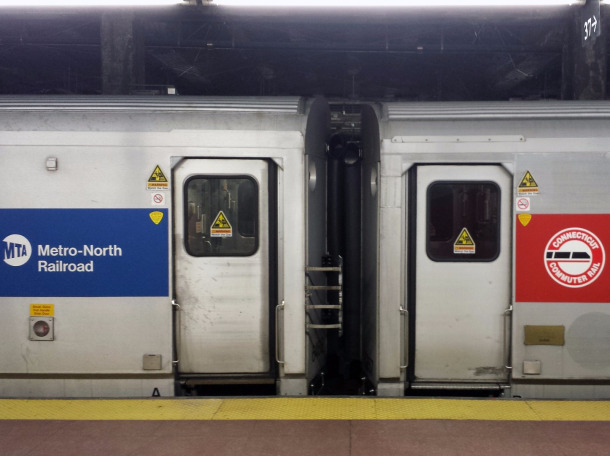


 The MTA is renovating stations along the BMT Sea Beach but not taking the opportunity to deck over them further, and make developers pay for renovations, in exchange for building taller. Bay Parkway Station is pictured above. (RR)


Leave a Reply