
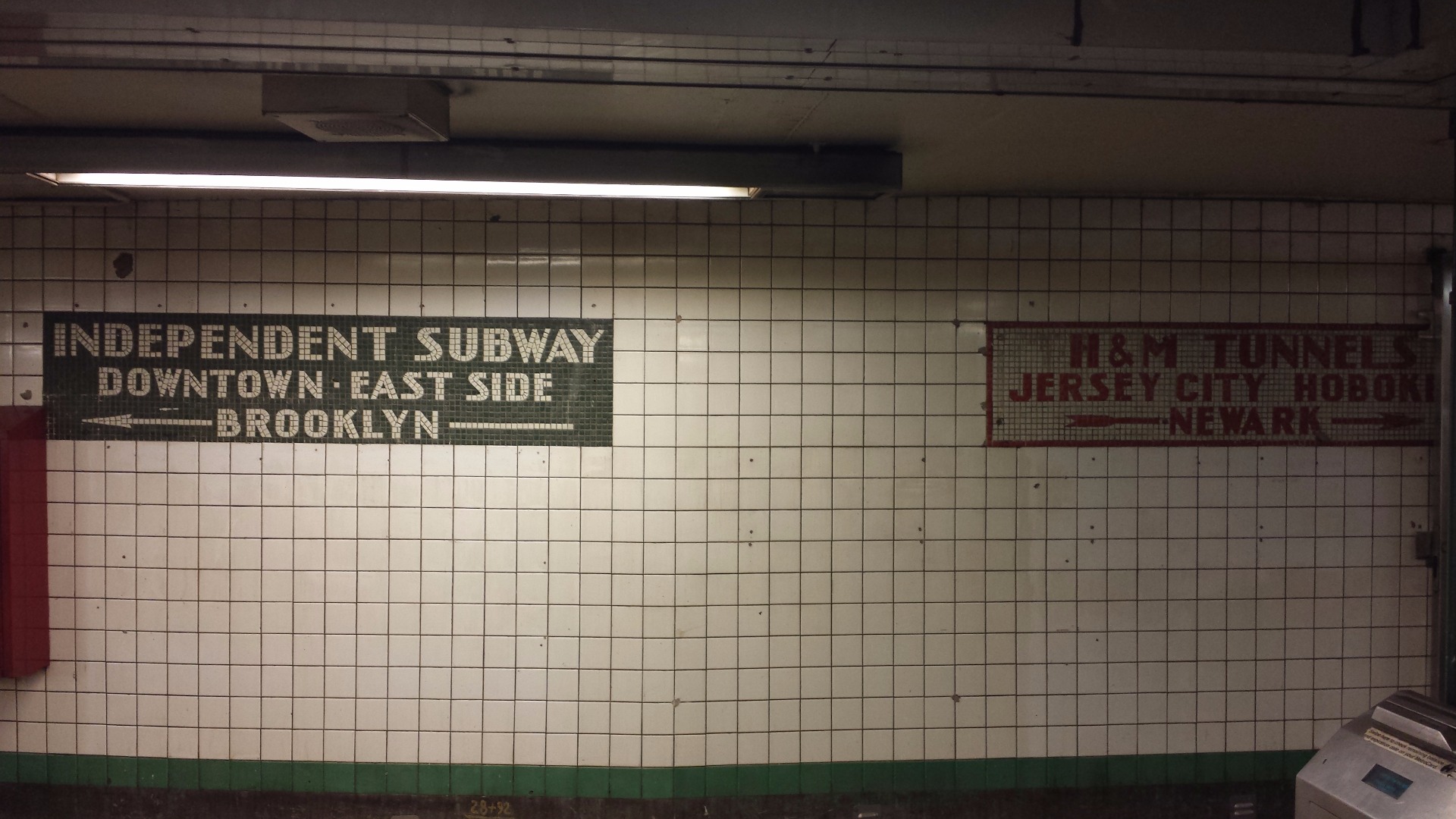
From the Independent Subway to the Freedom Tower, Americans rightly love their independence and freedom. But our affinity for liberty can be bad for urban planning, because it can hinder collaboration, coordination, and compromise. State’s rights and municipal police powers combine to make regional planning particular difficult in the United States. In the New York region, three states (governed by faraway capitals), and numerous municipalities, independent authorities, and additional assortments of political districts attempt to operate a region that has more people than the continent of Australia.

.
While our country remains divided between North and South, and between urban and rural, our region remains divided no longer because of geography, but because of politics. Our harbor and our rivers have been tunneled under and bridged over, but political boundaries remain. Transportation infrastructure can bring us together, but it can also separate us, when it’s operated in silos, without ample communication and coordination. Agencies have different mandates, funding sources, governance structures, and institutional priorities. Each entity wants control, and sharing control, or even sharing information, carries risk. After all, if the MTA shared all of its data with the DOT, for instance, the DOT could then use that information to apply for limited grants.
As a result of a lack of regional planning, we’re left with a disjointed transportation network. Most New Yorkers don’t know that the Governor governs the MTA and New York City Transit, or that NYCDOT is an entirely separate agency. We have MTA and Port Authority bridges and tunnels, and then toll-free DOT bridges, leading to congestion. And below the Freedom Tower, the PATH doesn’t physically connect with the NYC Subway, although H&M had originally planned for a physical connection. And there isn’t even a free transfer; it also doesn’t show as a 24/7 rapid transit system which accepts MetroCard on the NYC Subway Map. The IRT, BMT, and IND only started showing up on the same map in the past few decades. All of this freedom and independence has its consequences.


.
Highways, for instance, definitely brought freedom through mobility (for whites), but divided neighborhoods, creating social, economic, political, and physical gaps. In St. Paul, an entire African-American neighborhood, Rondo, was divided, and businesses were destroyed. There are now plans to not only bridge the gap, but fill the void, by decking over the highway. The land bridge would be built contextually, and designed around the community’s values. If they are united, they’ll have a better chance at securing funding for the project, and perhaps they can use the real estate created from the decking to help pay for it. (The Skyway System‘s of Minneapolis and St. Paul are some of the best-known public spaces in the region, and they’re largely privately-owned. Unlike New York, the sidewalks of these cities are on the second floors of downtown skyscrapers, and they’re connected by bridges across the CBDs. Retail is within buildings, to keep everyone warm during the winter, and it’s certainly convenient, but it also closes early, and causes the actual sidewalks to feel quite empty.)


.
Rondo residents realized that they’re stronger together, united, which is why the thirteen original colonies came together and formed the United States. It’s why the European Union, which can be reached by crossing a bridge from Brazil, was formed. It’s also how Boston advocates fought against a highway project, and got the Southwest Corridor built for the Orange Line, MBTA, and Amtrak. There are even ‘land bridges’ above it, known collectively as the Southwest Corridor Park, though I think they should have built taller station structures as well, and included retail, such as a supermarket for residents, which would also have provided revenue to the T.


.
Our differences can bring us apart, or we can choose to come together as regions. Some of our most important cities were planned to bring people together. Ottawa, the capital of Canada, bridges the gap between Quebec and Ontario, and public transit connects French Canadians with English Canadians. Washington, D.C., also attempts to bring together the Northern states and Southern states. Canberra’s garden city design was also intended to unify Australian states.


.
The WTC, atop the PATH terminal, was meant to revitalize Lower Manhattan, and help it to compete with Midtown, which is far closer to Penn Station and Grand Central Terminal. The windswept superblock had its own ZIP code, and it was subsidized until its privatization, only months before 9/11, when Larry Silverstein entered a 99-year lease of the site. And the Port Authority’s PATH was largely built by the Hudson & Manhattan Railroad, but then the railroad went bankrupt because of declining ridership, mainly due to the Port Authority’s new vehicular tunnels, and especially the Holland Tunnel.
The Port Authority eventually took ownership of the H&M as part of a deal between New York and New Jersey to construct the Port Authority’s World Trade Center on the west side of Lower Manhattan, rather than the east side. Since the PA is a bi-state agency, New Jersey wanted the WTC to be closer to NJ, and they agreed to take over the H&M because it terminated at the site that would become the Twin Towers, then known as the Hudson Terminal, the predecessor twin towers of the original WTC. (The New York City Subway doesn’t leave municipal boundaries, because it was built by the City and by private companies under contract with the City; H&M was built between municipalities, and connects Newark with Hudson County and New York City.)
That takeover was a major example of interstate compromise. More recently, the Port Authority has faced criticism over costs, governance, project delivery, and political interference. The agency’s new WTC hub cost $4 billion, spent largely on architectural elements, with few capacity improvements for PATH riders. The agency’s main cash cow, the world’s busiest motor vehicle bridge, was used for political vengeance. And, it can’t seem to collaborate, either. Following 9/11, the Port Authority had an opportunity to unite the PATH to the IRT via the 6 Line, which was once a serious plan for the H&M. The rebuilt WTC ultimately maintained PATH and the subway as separate systems. A physical integration was not pursued, illustrating how difficult institutional integration can be even where networks operate immediately beside one another.
Did they forget that the Statue of Liberty was built as a collaboration between the French and the Americans? Did they forget that they, themselves, are supposed to bridge the gap between New York and New Jersey, not only physically, but socially, economically, and politically? They may not be physically burning bridges, but they’re certainly cutting themselves off from their sister authorities. Many peer metropolitan regions provide more integrated fares, maps, and operating structures across regional transit modes.
Our region has a serious problem, and it runs deeper than the subway. The Hudson River is a political wall that has divided our region into New York and New Jersey since the King of England, Charles II, decided to reward New Jersey as a new colony to his allies. But it’s not just the Port Authority. Our institutions, in general, seem to be under threat from rising costs and rising seas.
The British may have perfected a strategy of dividing and ruling, be it here at home, or in Africa or the Middle East. But the United States was founded by uniting competing colonies under a common flag, because it was realized that united as one, the thirteen colonies would be stronger. Our country’s separation of powers, including delegating most power to states, makes collaboration and compromise far more important than, say, their importance in a unitary state. Our freedom was possible because we united, collaborated, and trusted each other, despite serious differences between the colonies.
In these divided days, it seems as though we’ve forgotten how to collaborate and compromise; the British, unfortunately, have also been losing trust in their region (and amongst their own countries), having divorced themselves from the European Union under the leadership of David Cameron, whose wife is related to Charles II, the monarch that divided New Netherland into separate states along the Hudson River. As individuals, we can now connect with each other around the globe instantaneously, but our institutions appear to be growing more and more disconnected. The Supreme Court’s vacant seat cannot be filled, and politicians seek to divide us and build walls. Our bridges and tunnels are supposed to connect us, but instead, they’ve been used to divide and polarize..
From Berlin and Belfast to Jerusalem and Cape Town, transportation infrastructure can be used to bridge the gap, or to burn bridges. While Berlin was divided, train service was also divided; and, Belfast’s peace walls, which remain active, effectively keep people segregated, halting movement across entire areas of the city during nights and weekends, which surely leads to inefficient, costly bus routes and commuting patterns. Today’s inefficiencies in New York, such as a lack of free transfers between the PATH and the HBLR or NYCT, seem comparatively rather insignificant.


Belfast’s Peace Walls (RR, 2016)
And then, there’re the times that we have come together. The Brooklyn Bridge created a lasting connection between New York and Brooklyn, allowing the cities to connect and consolidate to form America’s largest region. In Istanbul, a rail tunnel now connects Europe with Asia; in the British Isles, the Channel Tunnel brought the United Kingdom closer to Europe, while the Enterprise train service connects Dublin with Belfast. On the Continent, the Gotthard Tunnel, newly completed as the world’s longest and deepest tunnel, helps to connect the EU. And by 2017, a new high speed line in Germany will finally reduce travel time between downtown Berlin and downtown Munich by 2 hours, after being planned following German reunification in 1991, and the reorganization of Deutsche Bahn. The track has been fitted with the new European Train Control System, which harmonizes Europe’s different signaling and protection systems into one.
These projects were completed because leaders agreed to collaborate and work together. The Channel Tunnel and Eurostar are both complex, profitable P3s, and ownership is shared amongst various stakeholders. It wasn’t easy to get these players to work together; the British, living on islands apart from the Continent, have always felt distinct and, perhaps, fearful of the mainland. Would the Chunnel harm national security? But they eventually got it built, even though the UK never joined the Schengen Area, or adopted the Euro.
Meanwhile, the Enterprise, a train that connects the Republic of Ireland with the UK’s Northern Ireland, is jointly operated by Ireland and Northern Ireland. This service has also not been without its problems; during the Troubles, it was frequently halted by bomb threats, and there was even a Peace Train Organisation, which rented an actual train to campaign for peace. It’s also not the fastest or most reliable service, and now that the UK has left the EU, if Northern Ireland does not secede to join the Republic, there will soon be border control between Ireland and Northern Ireland, impacting service. (Ireland was not in the Schengen Area so that it could remain in the Common Travel Area with the UK, but now that the UK is not in the EU, there may need to be border control between the EU and the UK.) In the U.S., urban planning projects ranging from the Atlanta BeltLine to the Miami Underline are also bridging the gap and filling the void.


.
In the 21st century, regional collaboration is necessary for success. Brexit may have passed in the UK, but Staten Island secessionists haven’t yet succeeded with a ‘Staten Isleave’ campaign. This is because most Staten Islanders understand that being a part of NYC has more advantages than being apart from it. Perhaps they see the political battles between New Jersey and New York, regarding funding for the new North River rail tunnels to Penn Station, and don’t want to have to deal with battles with the City, if they were to secede. All of that extra time adds costs to projects, and it’s rather inefficient.
For instance, the Tappan Zee Bridge was built over the longest span of the Hudson River, raising costs, with cheap materials, so it now needs to be replaced while the Brooklyn Bridge, built a century prior, remains standing. It was built over the longest span possible because it was far enough from the grasp of the Port Authority, which governs the Hudson River 25 miles from the State of Liberty. By building outside of their control, New York State’s Thruway Authority (not the Bridge Authority) could maintain control.

.
New York may be a global city akin to London, but London is the capital of the United Kingdom, while New York is not even the capital of the State of New York. Our region’s transit network is prone to far more infighting because we’ve got New York, New Jersey, and Connecticut, all of which are governed from faraway capitals.
Greater London’s transportation is essentially entirely governed by TfL, which is responsible for London’s network of principal road routes (and congestion pricing), for various rail networks including the London Underground, London Overground, Docklands Light Railway, and TfL Rail, for London’s trams, buses and taxis, for cycling provision, and for river services. The underlying services are provided by a mixture of wholly owned subsidiary companies (principally London Underground), by private sector franchisees (the remaining rail services, trams and most buses) and by licensees (some buses, taxis and river services). London’s governance structure provides a more unified regional framework for many transportation functions than exists in metropolitan New York. This would be equivalent to an agency in our region operating most of the functions provided by the MTA, NJT, ConnDOT, Port Authority, and DOT, and it would also mean that our region would not be governed by faraway places. Moreover, it could mean that we’d have better incentives for performance, since many services in Greater London are privatized. (To be fair, London was ‘governed’ by Brussels until Brexit.)
New York once had a plan for the consolidation of our regional rail network, and it was published by Tri-State, the region’s MPO that has since been severed into separate MPOs for each state.
Decades ago, with the City in dire financial straits, the State had to rescue the City’s unified subway system and bring it under MTA control. The unified IRT, BMT, and IND system was governed by the NYC Board of Transportation from 1940 until 1953, when it was replaced by the New York City Transit Authority. As a public authority, NYCTA was more removed from City politics than the former Board of Transportation, so it could raise the fares and set transit policy more effectively. Technically, NYC continues to own the subways, but leases them to NYCTA, which became part of the MTA when Governor Rockefeller and Mayor Lindsay brought Robert Moses’ Triborough Bridge and Tunnel Authority into the MTA, and used the toll profits to help fund the NYCTA. As a related part of this deal, the union received a generous retirement agreement, and many employees with extensive experience soon retired, creating a lack of institutional knowledge. But, this streamlining stopped at the state border, with a few exceptions, such as contracts with New Jersey Transit for MNR service on the Port Jervis and Pascack Valley lines, and contracts with Connecticut for Metro-North service on the New Haven line.
Streamlining can be difficult, however. Courtesy of NextCity:
While it is theoretically the master, in practice the MTA remains a very loose coordinating body, a bossy group that constituent agencies see more as a hinderance than a help. In 2002 there were plans to merge the two commuter railroads — Metro-North, which serves the city’s northern suburbs, and the Long Island Rail Road — into an entity called MTA Rail Road, but they never got anywhere.
One aspect of the 2002 reorganization did end up happening, when major construction projects across the various railroads were merged, a year later, into what is now known as MTA Capital Construction. But far from being a model of efficiency, Capital Construction has, in the intervening decade, proven itself as the most inept part of a very troubled transit authority. Its failure is most obvious in the East Side Access project, where the MTA is building a new Long Island Rail Road line from Queens into Manhattan, along with a new terminal below Metro-North’s Grand Central Terminal.
Grand Central has more tracks than Metro-North knows what to do with, and could have accommodated both existing Metro-North traffic and the new LIRR service out of the same massive, century-old terminal. But Metro-North didn’t want to “share its toys,” as a few people have put it, and so MTA Capital Construction is digging a multibillion-dollar hole in the ground for the exclusive use of the LIRR. It’s been the biggest driver of the project’s monstrous cost overruns, and was a mistake that a true coordinating body should never have signed off on.
Beyond a total lack of coordination, the creation of MTA Capital Construction also destroyed decades of institutional knowledge built up at the New York City Transit Authority, which had hitherto managed the city’s largest transit construction projects.
“They’ve screwed it up,” David Gunn, former Transit Authority chief and all-around American railroad veteran, said of Capital Construction during a phone interview in 2012. “They had a really good construction department at the Transit Authority. For whatever reason they centralized it at the MTA. They drove off or retired some key people at the Transit Authority, and that was a terrible mistake.”
Grand Central brought the trains of the New York Central and Hudson River Railroad, the New York and Harlem Railroad, and the New York and New Haven Railroad together in one large station. Today, railroads of the same agency can’t be brought together in that same station. Instead, LIRR will be deep underground and isolated, taking a long time to access. But, to be fair, the grade necessary for bringing LIRR trains into existing the Grand Central tracks would lower throughput, and they’d also need to figure out how to install over-running third rail for LIRR trains.


.
New York Central had electrified with under-running third rail, while LIRR had electrified with over-running third rail. So while B Division subway trains cannot fit in A Division subway tunnels, and while A Division subway trains are dangerously narrow for B Division revenue service, MNR trains cannot operate on over-running third rail territory, because their shoes won’t fit; the same is true for LIRR trains on under-running third rail territory.
The New York, New Haven, and Hartford Railroad electrified with overhead power, so today’s New Haven trains have shoes for under-running third rail as they enter New York Central territory, and also take overhead power along their main corridor. MNR also has hybrid locomotives for service into non-electrified territory, such as northern portions of the Hudson Line. Amtrak’s Empire Service has over-running third rail shoes, because these trains enter Penn Station, and the shoes on the hybrid locomotive are folded up in order to clear MNR’s under-running third rail on the Hudson Line. MNR’s hybrids do not have retractable third rail shoes, and don’t take over-running third rail, so they wouldn’t be able to enter Penn Station. Also, EMUs can’t take the Empire Connection, because it is only electrified at Penn Station.
Similarly, the MNR service from New Haven to football games in the Meadowlands operate with NJT equipment and overhead power. While they’re essentially using Amtrak’s NEC route, which has overhead power, the section of over-running third rail at Sunnyside for the LIRR would cause MNR trains with third rail shoes to not proceed. Overhead power can’t be used for the LIRR, since overhead infrastructure ends when Amtrak heads towards the Hell Gate Bridge at Sunnyside, and third rail power can’t be used in New Jersey, since there’s only overhead power there. Hybrid locomotives would probably be needed, since it would be more expensive to install third rail along the Hell Gate Bridge and in New Jersey, and then build a locomotive that takes over-running and under-running, like the retired EMD FL9, which required extensive maintenance. Once East Side Access is completed, MNR could send some of their trains to Penn, since there’ll be some room for them.
Regional through-running would need to take all of these quirks into account, and coordination with the MTA, ConnDOT, NJT, Amtrak, and freight companies would be necessary.


.
All of this extra coordination raises costs. Robert Moses was able to fund his projects because the TBTA was self-sufficient, and he also did not need to do much external coordination, since he was a power broker and controlled various political entities. This culture arguably persists in our public authorities today, even though the Port Authority uses its profitable enterprises to subsidize PATH, while the MTA uses Moses’ former empire to help fund mass transit. At one point, the Port Authority was considered as an operator for the New York City Subway, and perhaps that would have caused New Jersey to force the connection between the PATH at the World Trade Center and the IRT along the 6. After all, unlike the MBTA subway (or the PATH), which services many municipalities, the New York City Subway doesn’t leave NYC because it was proposed by the City and contracted out to private operators.

.
The original railroad, H&M, which owned and operated today’s PATH, had planned for a connection with the IRT, but it never happened. Now that the Port Authority has made a connection impossible with their new WTC hub, it’s doubtful that the PATH will be connected. Even though they run next to the IND 6th Avenue Line, the trains are too narrow for the B Division. (When the IND 6th Avenue Line was being constructed, original proposals included widening the H&M tunnels for IND service, since H&M tunnels were built narrower than IND or BMT tunnels, akin to IRT tunnels. While this level of cooperation wasn’t achieved, the IND did rebuild H&M’s 33rd Street Station, since it needed to be relocated one block south in order to fit the IND 34th Street Station concourse. As a result of this change, H&M closed their 28th Street Station, now too close to their new terminal.)
But rest assured, in any other developed country, the PATH would have been connected with the IRT decades ago (perhaps with the 1 or 6), and a $4 billion project to renovate a terminal would have included a physical connection with the rest of the subway system. But in the United States, founded only by uniting colonies in exchange for ample states’ rights, public authorities would rarely voluntarily elect to share power, and lose their freedom and independence.
True, PATH is regulated by the FRA, not the FTA like the NYC Subway, because it used to share trackage with the PRR between Harrison and Journal Square. While this connection has been severed, it has numerous additional FRA regulations, which raises costs. It could seek to be let loose of the FRA, and if it does, perhaps considerations for a connection to the NYC Subway could be made, or at least, PATH could be shown on the NYC Subway map as a 24/7, underground, rapid transit service in Manhattan and Hudson County, which accepts MetroCard.

.
Long Island Rail Road had also planned for a connection with the IRT at Atlantic Terminal in Brooklyn, and they even had a ROW for it, while the IRT built a switch, until the ROW was later filled by LIRR ticket booth offices. Atlantic Terminal could have been a station, not a terminal, and the LIRR could have used narrow trains that fit onto subway tracks. The IRT could have granted trackage rights, similar to how the IRT granted rights to the BMT in Queens, or how the LIRR operated joint service with the BRT along the Atlantic Branch. But, Atlantic Terminal fell into decay, and many of its platforms were removed from service; today, there is little remaining evidence of the former ROW. Proposals to extend the LIRR to Lower Manhattan, or to extend the PATH to Atlantic Terminal, continue to surface from time to time.

.
Yet even within the MTA, operating agencies tend to not want to cooperate with each other; the LIRR’s culture remains quite different from the MNR’s, because unlike the MNR, formed as a new agency from the ashes of Penn Central and Conrail, the LIRR has been around for more than a century. (Though, the 63rd Street Tunnel was planned well, decades ago, as they had the foresight to include a ROW for the LIRR’s East Side Access. And the Roosevelt Island Station is apparently powered by tidal energy generated by turbines under the East River. Plus, the Roosevelt Island Tramway, operated by a contractor for the Roosevelt Island Operating Corporation is one of the few forms of mass transit in the City that is not operated by the MTA, but takes the MetroCard and has free transfers to the MTA.)


.
Now, due to East Side Access, the Atlantic branch of the LIRR may become a scoot service, at least partially, because Jamaica Station‘s platforms are set up for three-way transfers to and from City Zone terminals: 1-2-3, 4-5, and then 6-7-8. Trains are coordinated to arrive at certain times, and passengers can travel between the opened doors of the train on the center track (2 or 7), to track 1 or 3, or 6 or 8. Diesel trains to Long Island City will continue to operate from eastern Long Island, providing direct service to NYC, and Penn Station and GCT service will also eventually be provided, meaning that some Atlantic trains will be operating between Downtown Brooklyn and Jamaica, at a new platform that’s being constructed.


.
If this service becomes isolated, perhaps it could be turned over to the NYC Subway. The Long Island Rail Road is one of only two American commuter rail networks to use third rail power (with the other being Metro-North), so the connection to the subway would not be too difficult. Unlike Metro-North, LIRR uses over-running third rail, because it had planned on connecting with the IRT, which used over-running third rail because under-running third rail hadn’t been invented yet. Over-running third rail causes more problems than under-running third rail, because it is more dangerous, and it also is more exposed to the elements. But, it’s there and it’s not going to be changed.
In the 1900s, this branch was considered a subway branch because it had been placed in a tunnel along Atlantic Avenue and electrified, due to a ban on steam locomotives within the City of Brooklyn. Many stations along the street were closed. Maybe it will become a part of the subway, or maybe it won’t; hopefully, it won’t simply get demolished, considering it’s the fastest rail route in Brooklyn, and it doesn’t even change slope by going above ground for portions of the branch. It would be a complete waste to be demolished, since Atlantic Terminal was just updated, and the elevated trestle was repaired, along with station improvements. Keeping it would also provide a fast link to JFK Airport via the AirTrain at Jamaica.
Atlantic Avenue is not only an LIRR corridor. In fact, it is a major east-west vehicular corridor in Brooklyn, but it is also one of the city’s most dangerous. Ironically, despite providing for mobility, it also creates immobility in the neighborhood, as it is far from an urban street. Vehicles speed along the corridor, which is lined with auto body shops. However, DOT and DCP have been working to redesign the corridor to be pedestrian-friendly, focusing on improving safety and convenience for pedestrians and bicyclists, and also improving transit access and, potentially, exploring rezoning. Mayor Bill de Blasio’s affordable housing plans have identified the Atlantic Avenue Corridor and East New York as priority areas for renewing, enhancing, and expanding affordable housing options. The City and the MTA should work together to improve this area.
New York will only continue to thrive if it is connected and coordinated. But New Yorkers do not understand that renewing, enhancing, and expanding infrastructure requires temporary inconvenience. Uproar ensues at any change, accompanied by fears of gentrification and displacement. Naturally, this makes politicians nervous, and limits the scale of projects, while raising costs.
In the end, it is not just about physically connecting railroads. It’s about socially, economically, and politically connecting people through collaboration. Instead of building walls, we should be bridging the gaps, filling the voids, and thinking beyond boundaries, as Masdar City has done in the UAE.


Masdar City (RR, 2016)


Leave a Reply