New York City does not lack visionaries or visionary plans with hindsight, foresight, and insight, but these visionaries lack power. America has spent trillions rebuilding Iraq and Afghanistan, but when it comes to maintaining the infrastructure of a region with a $1.4 trillion GDP, money can’t seem to be found.
Unfortunately, the British did not only mess up African and Asian borders, but also American borders. While no third-order enclave, Charles II decided that the border between New York and New Jersey should be the Hudson River, cutting up the global city and transportation agencies of the future. Plus, unlike London’s Underground, right in the heart of the U.K., New York City does not even control its own subways. Albany does. Talk about dropping dead when it comes to the back-and-forth of financing mass transit in America’s biggest city.
Center City Commuter Connection in Philadelphia (Riel, 2015)
Rapid industrialization and urbanization created chaos and congestion on America’s streets. Horse-drawn carriages were dirty and slow, riding over cobblestones and heaps of manure. Streetcars had to run slowly in order to not hit pedestrians, bicyclists, or animals. Elevated railroads would literally rise above the congestion, and hundreds of companies invested in this technology in order to make it a reality in American cities.
Old Fifth Avenue Elevated ROW in Brooklyn at 36th-38th Street Yard (Riel, 2015)
.
These railroads were largely privately financed, and some were owned by developers who fueled ridership by, for instance, building hotels and resorts in Coney Island on railroad real estate. It was a building frenzy, with elevated railroads built atop surface-level railroads, being bought and sold, eventually becoming part of the BMT and much later, the MTA. While these areas are dense, built-up sections of NYC today, we must remember that, at the time, a large portion of these outer boroughs was still farmland or even woodland, and the controversial, fragile, narrowly successfulconsolidated City of New York was only a few years old at the time. Railroads (and later, subways) helped connect and develop the city, and today, sections of these railroads exist in pieces, and hints of the former Culver Line and Culver Shuttle remain, though it is obviously not the same as the original infrastructure.
Culver Line Coney Island Hub (Source: http://forgotten-ny.com)Culver Line ROW at 36th-38th Street Yard (Riel, 2015)Culver Line ROW at 36th-38th Street Yard (Riel, 2015)Culver Line ROW at 36th-38th Street Yard (Riel, 2015)
.
Imagine if these structures had been maintained and improved, brought back to the glory days, akin to the iconic as Chicago’s Loop? But they were destroyed because the TA had no money for repairs, ridership was declining, and the City was bankrupt in the 1970s. Now, the city has as many subway riders as in the 1940s, with fewer track miles, and with an old system. Sure, many of these lines were made redundant by subways (i.e., 6th Avenue in Manhattan replacing the 6th Avenue Elevated or 4th Avenue in Brooklyn replacing the 5th Avenue Elevated), but many more were never replaced with subways, such as the Culver Shuttle or Second Avenue Subway. The structures were falling apart and they were negatively impacting real estate values, but surely they could have been fixed if there was any semblance of political support. Ironically, railroads built by real estate were now being destroyed partly by real estate pressure.
Source: http://nycsubway.orgBaltimore and Philadelphia Streetcars (Riel, 2015)Source: Baltimore Streetcar Museum
.
Buses and automobiles took over, suburban sprawl divested from the city, and the Second Avenue Subway was never built to replace the old, dilapidated elevated. The Great Depression, coupled with numerous contractual regulations (such as maintaining the 5 cent fare) spelled bankruptcy for the private operators of the subways. The city took over the subways, and eventually the MTA took over NYCT. While the city had not allowed the IRT or BMT to charge more than 5 cents, the MTA has continued to raise fares. Unlike all other American public transportation agencies, NYCT could theoretically cover operational expenses if it continues to raise fares due to the uniquely impressive ridership figures for an American city. New York is a geographically constrained, old, and dense city, fueled by transit-oriented development vis-a-vis bridges, tunnels, subways, and in the olden days, the Erie Canal. TBTA makes a surplus from tolls. Why can’t NYCT charge more? Adjusting for inflation and other bonuses, it costs less to ride the subway than it did in 1996, and New Yorkers don’t even need to own a car or pay for gas. They get a flat subway fare. Many cities charge a lot more.
How can the MTA get the funding necessary to build for the 21st century? Albany and D.C. will continue to provide, but perhaps the MTA will be more efficient if it can generate more of its own revenue. Yet the fares will probably not continue to increase, because…
State and local pols ensure that the price of a subway ride falls far short of the actual cost, but refuse to make up the difference with reliable subsidies. Meanwhile, the political clout of the Transport Workers Union (TWU) ensures that that cost is outrageous, thanks to lavish labor contracts and pension benefits. So the MTA, squeezed from both the cost and the revenue sides, runs chronic operating deficits that are about to become unsustainable.
The “dysfunctional state of the MTA” has not always been the case. The profitable and glamorous IRT was a first-class railroad, with clean bathrooms, complete with soaps and towels. They wanted ridership in order to make money and they did what they could to profit. But government got in the way. Believing that transportation was a human right instead of a private good, they forced the IRT to keep a one nickel fare, even after two wars, the Great Depression, and triple-digit inflation. They also forced them to build into rural areas of the Bronx, Brooklyn, and Queens, in order to allow the poor to vacate crowded Manhattan slums. While the city helped fund these expansions, some of these routes in the Bronx literally swept across farmland. The IRT moved trains, and ideally a lot of people as well. In these peripheral areas, they were losing money. Yet the city forced them to keep the fare at a nickel, while the government built highways and sent white people sprawling into the suburbs. Ridership declined. Service deteriorated. The private operators could no longer compete. They were done.
Mayor LaGuardia bought the assets of IRT and BMT, thinking that unification would allow for greater efficiency. He did not think that subsidizing transit would work, because that would allow for “financial waste and irresponsibility”. If it is not their money, after all, they’d spend it so that they could get even more.
After unification, the subway operated within a very different financial and labor framework. Rising labor and maintenance costs, fixed-fare policies, deferred investment, changing travel patterns, and political funding decisions all contributed to long-term fiscal challenges. The history does not point to a single cause; it shows how ownership, regulation, labor agreements, funding, and accountability interact. Mayor LaGuardia believed unification could improve efficiency and make transit more directly accountable to the public. Public ownership, however, also changed the subway’s financial and governance structure.
The public-private partnership opportunities for the MTA are being explored with DCP, NYCEDC, and countless developers. Air rights transfers are being discussed, and developers are also planning sites atop stations, such as SL Green at GCT, and Vornado at Penn Station. It may seem like nothing is getting done, but they’re talking about it…
The Moynihan Station Project will redevelop the McKim, Mead & White designed and landmarked James A. Farley Post Office Building into the new Manhattan home for Amtrak, transforming a treasured building into an iconic railroad passenger station and mixed-use development befitting New York City.
The Project is advancing in phases, and the first phase is now under construction.
Phase 1 consists of three separate construction projects:
West End Concourse Expansion – This project will create access to the Penn Station tracks and platforms through the James A. Farley Post Office Building for the first time. The new entrances at the corners of 8thAvenue and 31st and 33rd Streets will provide commuters with access to an expanded and ADA-compliant concourse underneath the Farley Building that will serve tracks 5 – 21 and serve as the commuter concourse for Moynihan Station.
Connecting Corridor Expansion & Rehabilitation – This project will expand and rehabilitate the underground connecting corridor between the new West End Concourse and existing Penn Station, and it will include new and reconfigured subway entrances for the A,C,E subway station that will ease passenger flow.
Emergency Ventilation System – This project will install a state of the art emergency ventilation system for the railroad platforms under the Farley building, increasing safety for the hundreds of thousands of passengers that use the facility each day.
In May 2012, MSDC awarded a $147,750,000 construction contract to Skanska USA Civil Northeast for the West End Concourse Expansion.
Construction on the West End Concourse Expansion began in September 2012 with the first weekend closures of individual Penn Station tracks and platforms in order to facilitate surveying, the relocation of utilities, and preliminary foundation work for the new concourse. This type of work will continue until mid-2014 when the technically challenging steel erection phase will begin.
In September 2012, the Federal Railroad Administration awarded Moynihan Station a $30 million High Speed Rail Grant through the New York State Department of Transportation for the Connecting Corridor construction and the first portion of the new Emergency Ventilation System. Construction on both of these projects will begin in mid-2013.
Of course, all of this takes time and investment analysis and it’s a lot easier said than done, especially without any analysis on my part. I know that I am just a student and that I have a lot to learn. I know that the Real Estate Department is working extremely hard to sell and develop its property. I know that the MTA has limited real estate assets; after all, they’ve carved up many mezzanines, concourses, passageways, and former track ROWs for various infill purposes, from offices to operations.
Infilling offices onto former IRT track ROW (Riel, 2015)
.
Yet today’s public authorities cannot even seem to share the spoils of the chopped and disfigured cavern of Penn Station in New York. One cannot take a train (without needing to transfer at Penn Station) from Long Island to the Meadowlands, the Prudential Center, or EWR in New Jersey, or from Newark to JFK or Citi Field and the US Open in Queens. Unlike SEPTA, which has connected its terminals in order to have through-running, New York has multiple agencies and they cannot cooperate. Money and politics keep the agencies siloed. While Governor Cuomo and Christie share the Port Authority, Cuomo would not want to share the MTA and Christie would not want to share NJT. As a result, the NYC Subway does not go to Hudson County, and the PATH does not connect with the NYC Subway. There is not even a free transfer. Even worse, NJT and LIRR terminate at Penn Station.
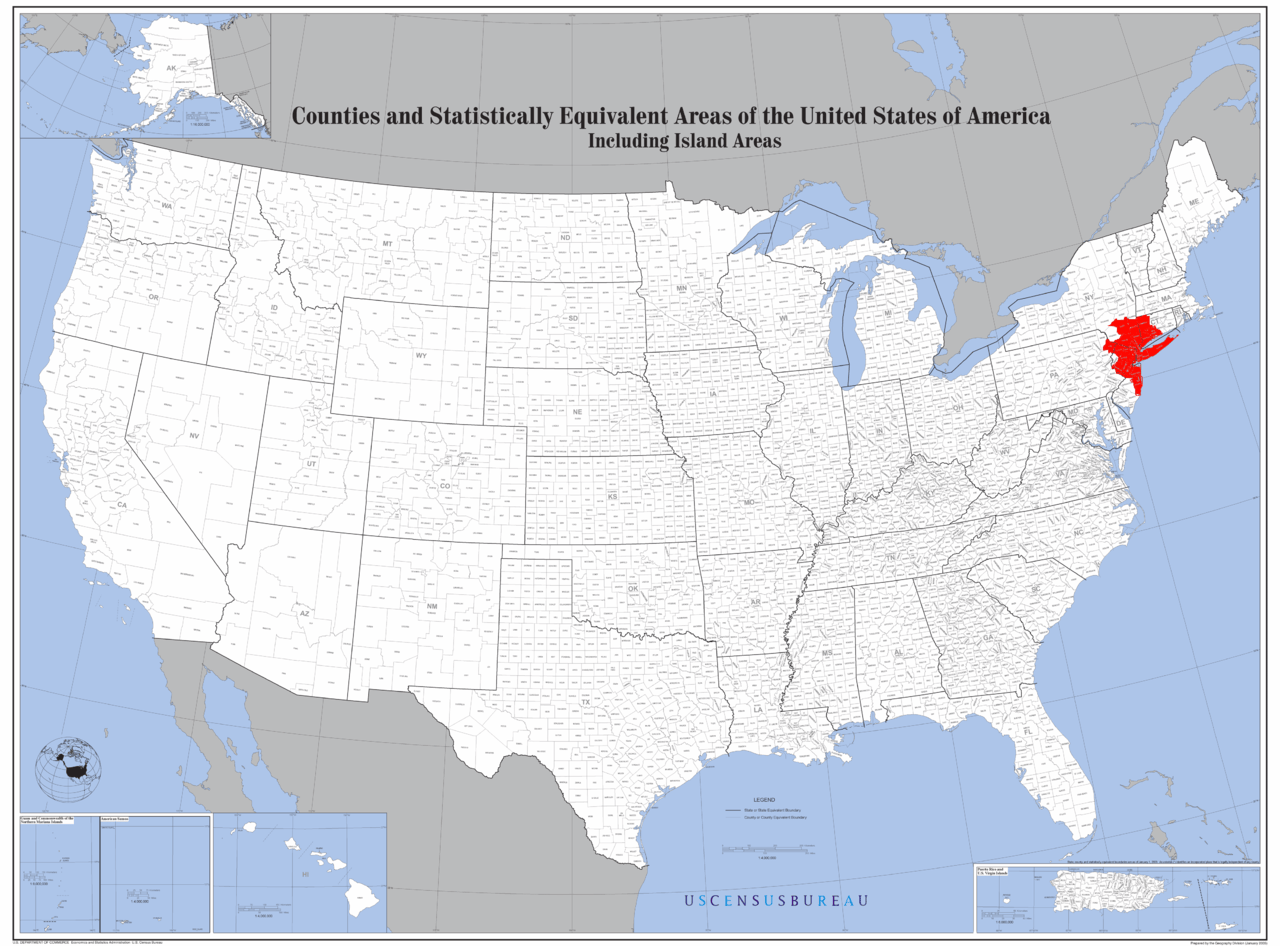
If I became the GreatKhan, I would merge the PA and NJT with the MTA, and I would get NYC to annex the counties in the metropolitan region in NJ, CT, and Long Island, and then secede from Albany, Trenton, and Hartford to form the Big Apple State. Consolidation of Dutch and later, English towns has happened before in order to form NYC, and it could happen in the future. With one, unified metropolitan transportation authority, the MTA could begin to aggressively transform into a real estate developer, without interference from Albany, Trenton, or Hartford. The metropolitan region would be one state, raking in approximately $1.4 trillion in GDP, ranking first nationally by a wide margin, and “behind the GDP of only eleven nations”. And it would explore congestion pricing and urban growth boundaries, having been permitted to do so by the Big Apple State’s capital, in NYC.
(The urban growth boundary in Portland, OR., required state permission, too. Portland is a liberal city surrounded by rich farmland and a beautiful countryside. Farmers did not want sprawl, and urban leaders also recognized the importance of creating an urban growth boundary and T.O.D. Nearby mountains made it easy to visualize urban growth, unlike, say, in Texan cities).
The reason why these agencies have not been cooperating? Politics. State boundaries would not matter for private, profitable railroads; after all, through-running was originally practiced at Penn Station by Pennsylvania Railroad before politicians chopped up the remnants of Penn Central Railroad. Moreover, the IRT, BMT, and Hudson & Manhattan Railroad (today’s PATH) operated profitable, competitive subway companies, responsible to shareholders. Today, most of these lines would not be profitable by themselves, because airports and highways have diverted business, and because the MTA has excessively high labor costs and 100-year-old maintenance needs. Plus, suburban sprawl decreases density, thereby decreasing ridership. So we are left with sorting out politics in order to fix our connectivity.
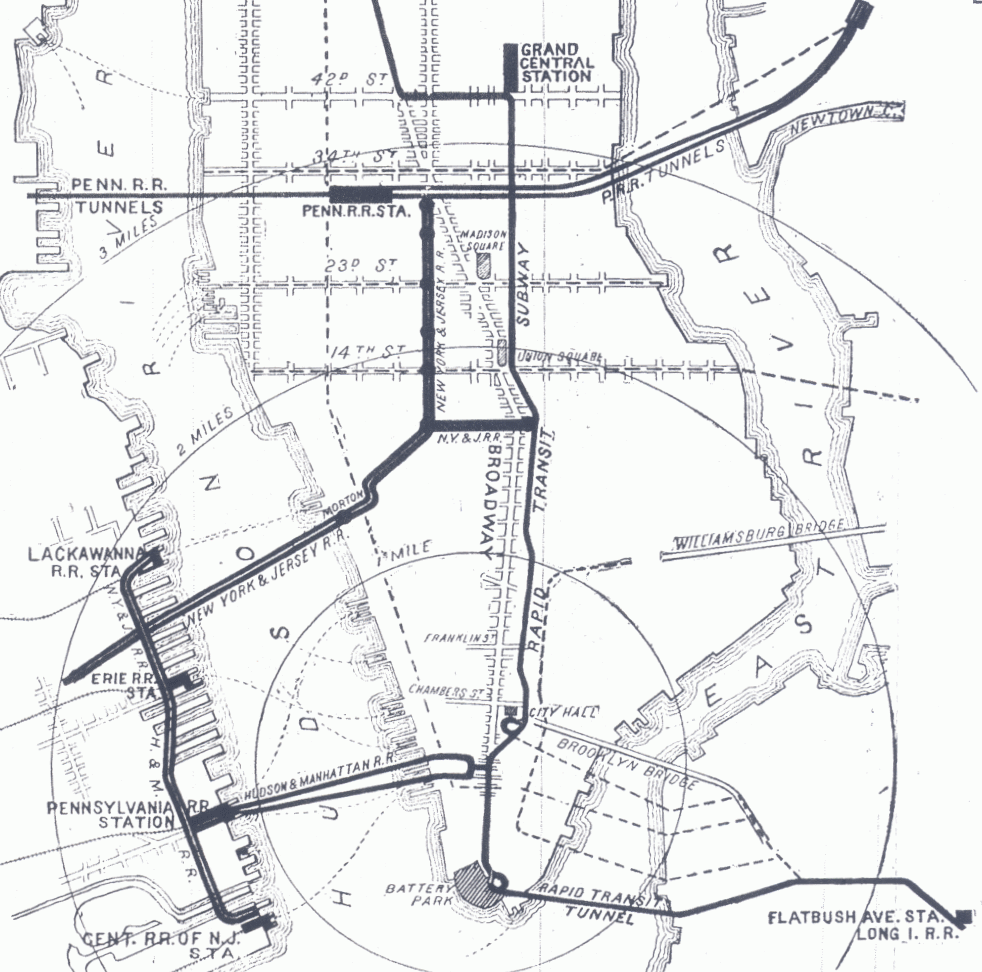
Hudson and Manhattan Railroad (H&M Annual Reports)IRT, BMT, IND Ridership Visualization
.
New York’s harbor made it an ideal global city, but its infrastructure connected and consolidated it. From the Brooklyn Bridge and the subways to the water tunnels, the benefits of pooling resources to physically connect trumped partisan concerns of taxation and demographic paranoia. When the subways were first built, the consolidated city was only a few years old, but the City mandated that the IRT and BMT extend outwards in order to develop the outer boroughs and alleviate the crowded, unsanitary conditions of Lower Manhattan’s slums. (Many in Brooklyn were originally worried that they would have to pay higher taxes for Manhattan’s projects, and that Catholics would change the fabric of their Protestant city…).
(These “sixth boroughs” – such as Bergen, Jersey City, and Hoboken in Hudson County, New Jersey, were actually originally part of New Amsterdam during the Dutch colonial area. Now, New Jersey’s Hudson Waterfront is so close yet so far, because the PATH is not connected to NYCT).
In the Big Apple State, the MTA, NJT, and Port Authority are not private companies, but they still do not want to share riders and fares. A PATH commuter needs to pay again in order to get on New York City Transit. If they would be combined, it would be easier to accomplish countless goals. If the Hudson Tubes need to be replaced, they could be reconstructed alongside a route for the 7 Line (akin to the 63rd Street Tunnel, which has F Line and LIRR East Side Access tracks). These regional rail tracks will go to Secaucus Junction alongside the 7 Line, acting as a local, and then a new bus terminal could replace the existing terminal atop Secaucus Junction. Secaucus has quick access to highways, and buses can terminate there in order to decrease congestion in the Lincoln Tunnel and in Midtown. This would knock out two (three) birds with one stone. Offices and apartments could also be built atop and nearby Secaucus Junction, and the real estate revenue would be a boon for the agency. In fact, a skyscraper atop Secaucus Junction was originally planned, but the recession knocked this idea down; however, some TOD has been built. Since the MTA, NJT, and Port Authority are not combined, this project is difficult to plan.
Other projects that are difficult to plan? Too many to describe. The AirTrain to JFK should have gone from Penn Station to LGA via Sunnyside, and then to JFK via the LIRR’s abandoned Rockaway Beach Branch.
AirTrain JFK (Riel, 2015)
.
Cuomo and Christie do not want to share legacy projects. The federal government does not want to help pay Amtrak (or for anything else), and New York and New Jersey do not want to share costs. Cuomo is correct that the Hudson Tubes are not “his tunnels” but he does not realize that the repercussions from clogging the Northeast Corridor will impact his tunnels and his economy, too. It will mean more automobile congestion in the City, and it will mean delays along the entire NEC, reverberating throughout New York State. Plus, in 2011, “New Jersey residents paid nearly $3 billion in income taxes to New York State”, which was “8 percent of New York State’s entire personal income tax levy”; in fact, “New Jersey residents were responsible for more of New York’s personal income tax than the residents of all but three New York counties: Manhattan, Nassau and Westchester” (via Dana Rubinstein @ Capital New York).
Regional planning has always been exceptionally challenging in the United States. It is a country with a grand diversity of regional values, founded by Jeffersonian ideals that granted more power to states than to cities. There are cultural regions, political regions, commuting regions, environmental regions, and so on and so forth. Watersheds may not match up entirely with ecoregions due to varying elevations and soils. Commuting regions definitely don’t always align with political regions.
In the New York commuting region, the Tri-State Regional Planning Commission ceased to function decades ago, with MPOs broken down into NY, NJ, and CT organizations, such as NYMTC for New York State. Without strong regional planning efforts, cities can promote density while nearby suburbs promote sprawl. Suburbanization had been the 20th century’s answer to urban congestion and chaos, and automobiles had allowed for separation to be efficiently designed and developed.
If the MTA does not have the tools to develop property, but it also lacks funding, perhaps a privatized development division of the MTA could be established. It would have to be entirely self-sufficient, and it would also have to provide the MTA will a stable source of revenue from leases or it will be shut down. This model would be the MTA’s response to the City’s Economic Development Corporation, which manages many of the City’s assets. In fact, governments across the world have set up independent entities to manage their wealth, such as Singapore’s government-owned holding company, Temasek, incorporated in 1974. By 2014, Temasek’s portfolio grew “to more than $75 billion”, while “across the globe, more than 20 national wealth funds manage more than $1 trillion in assets”. Yet it is estimated that governments across the world have approximately $75 trillion in commercial assets, and most of this remains mismanaged. The MTA is no exception, and neither is the Northeast Corridor and Amtrak. But they can change, if they are given the resources to build, build, build.
East River Ferry to Dense Midtown (Riel, 2015)
.
In order to have more of this…
Electric Bus in Quebec City, Canada (Riel, 2013)
Light Rail Redevelopment in Washington, D.C. (Riel, 2015)
Bus Lane in Columbus, Ohio (Riel, 2015)
Embarcadero Biking in San Francisco (Riel, 2015)
Biking in Washington, D.C. (Riel, 2015)
.
Instead of more sprawl…
Sprawl in Nashville, TN (Riel, 2012)
Road Diet Opportunities in Nashville (Riel, 2012)
Suburban Dayton, OH (Riel, 2015)
Typical Suburbia in West Virginia (Riel, 2013)
T.O.D. Potential in Town in West Virginia (Riel, 2013)
.
Arthur Nelson’s Foundations of Real Estate Development Financing: A Guide to Public-Private Partnerships elucidates the importance of public-private partnerships.
America’s future depends on public-private partnerships to facilitate redevelopment. Even though redevelopment generates higher rates of investment return to investors, numerous obstacles have to be overcome. Some of these involve changing planning and development codes to be more responsive to redevelopment opportunities. Others are expensive in the near term because infrastructure has to be upgraded – though it would probably have to be upgraded eventually anyway. Many involve land assembly brownfield remediation. Still others are related to the complexity of modern real estate financing, especially when it involves multiple land uses (Nelson 2014, 4).
Public-private partnerships, or P3s, are contractual relationships between public and private entities to facilitate real estate development. They can include the repurposing of existing real estate development through rehabilitation to change an original function, such as converting warehouses into residential lofts. It can also include the removal of existing structures, land assembly, infrastructure upgrades, and related activities to redevelop areas and sites. There are many forms of P3s, most of which engage the private sector in building, operating, maintaining, or owning and leasing back facilities to the public or nonprofit sectors (Nelson 2014, 5).
Each party contributes to the partnership what it does best. For the public sector, this can include planning and zoning activities that can recast the overall development vision of the area, upgrading infrastructure, expanding mobility options through sidewalks, bikeways, road improvements, and transit, as well as acquiring property and preparing it for redevelopment and assisting with financing. For the private sector, it can include market analysis, construction financing, construction management, procurement of long-term financing, and project leasing, as well as property management (Nelson 2014, 5).
According to a thesis written by Joseph Monty at my school, Tufts University, a P3 was necessary in order to manage the Massachusetts Bay Transportation Authority (MBTA)’s real estate assets. The internal department had to maintain the tenant ledger, collect rents, negotiate lease agreements, sell surplus properties, and respond to requests from developers. The T did not have the necessary resources, expertise, or profit motive in order to conduct these processes, so it contracted Transit Realty Associates (TRA), a consortium of firms, in order to outsource the T’s real estate division. Firms included: AW Perry, specializing in ownership, management and permitting; K.C. Donnelley and Company, specializing in brokerage; The Development Group, specializing in public property development and financing; and, Antrum Management, an engineering firm specializing in parking garages. According to Buzz Constable, a principal at TRA, the TRA had to organize hundreds of lease agreements, many of which dated back to the early 1900s, and were not cataloged at all. 80 percent of the T’s leased assets were non-performing; indeed, the T did not even have the time to collect rent or update property agreements, one of which dated to 1910. The TRA instituted market procedures and marketed properties for new lease opportunities, allowing for the MBTA to receive, from $3.5M per year in 1996, to $14M per year in 2014. The TRA also succeeded in creating a Land Tracker system with GIS, allowing for the organization of the authority’s portfolio. The GIS based system catalogs basic information including location, size, assessed value, rail line and station, use, zoning restrictions and environmental information.
Monty also writes that there are ample risks and ample rewards in a P3. For the public sector, perceived or real conflicts of interest, alongside a fear of the misuse of funds and resources, are compounded by land use conflicts (such as dislocation, relocation, or fair market value disagreements), public opposition, and worries that the private partner may fail. Meanwhile, the private sector is often concerned about excessive costs, time-consuming regulations, and accusations from the public; moreover, concerns that changes in key public or political leadership will derail partnerships are often concerns, alongside fears of market failures. Yet there are also plenty of rewards. For the public sector, of course, a P3 can provide for economic development, increased tax revenue, and improved public infrastructure and quality of life, whilst creating jobs and advancing the city’s image; perhaps, politicians would also be reelected due to their performance. For the private sector, a public partnership allows for resources to sustain their organization, and hopefully, the P3 is profitable, creating value, whilst enhancing their reputation and building their market niche.
According to Matti Siemiatycki in the Journal of Planning Education and Research, the public sector can alleviate most of its concerns by following five rules: first, establishing a jurisdictional constitution; second, separating the analysis, evaluation, administration, and oversight agencies; third, ensuring that the bidding process is competitive; fourth, maintain caution, especially for projects with long life cycles, due to contract renegotiation concerns; and fifth, avoid stand-alone private sector shells with limited equity. All of these rules are essentially about effective communication and trust, which can be aided by transparency. This commits partners to the project terms, be it private partners that would otherwise seek to limit their responsibilities, or public partners that would otherwise waver under political pressure.
In order to begin the joint development process, a financial feasibility analysis would need to be conducted. This would include the cost of decking and the land value based upon existing physical, demographic, and market conditions for relevant properties and parcels. It would also include relevant zoning, land use, and air rights laws, resolutions, and amendments. A development scenario would also need to be designed, showing the placement of buildings, amenities, entrances, ventilation, clearance, and circulation; access, egress, traffic, parking, terrain, and environmental review processes would intersect these scenarios. The concept and site selection would also be coupled by site assembly, site planning, and an organization of the management structure. A marketing strategy would also need to be implemented, and demand generators – factors such as renters, buyers, anchor stores, trade areas, market capture, and foot traffic – would need to be calculated based on market demand. Advocates, facilitators, lenders, owners, users, realtors, managers, tenants, architects, contractors, and brokers would all need to be involved with the transportation authority in order to produce the best program and form, full of flexibility, activity, and density. They would need to find the gross, find the net, find the cash flow, find the tax credits, find the appraised values, and find the assessed values. They would need to deal with permits, retail space, community space, open space, financial structuring, incentives, risks, rents, and leasing, as well as the hard costs, soft costs, fees, equity, and debt service. Then, there’s mortgages, loans, and operating expenses. No wonder there are so many professionals involved in the development process. And when it involves a public agency, with limited expertise and resources, P3s clearly become paramount.
.
Comments or opinions expressed on this blog are those of the author only. The views expressed on this blog do not necessarily represent the views of the MTA, its management, or employees, and absolutely no confidential information was disclosed.






Leave a Reply