


As many New Yorkers know, the rent is too damn high. The neighborhoods of New York have always been dynamic and ever-changing, and today, this continues to be true, but perhaps, on a level unforeseen in recent memory. Many are being priced out of our neighborhoods that they’ve lived in, sometimes for generations. So I asked Jimmy McMillan, the founder of The Rent Is Too Damn High Party, what he proposed to do in order to address exponentially rising housing costs. He told me that it was too complicated to explain right now, but that we could take a photo together… ironically, right next to a “PREMIER RETAIL FOR LEASE” sign…
Recently, I went to an NYU event with Richard Florida, the man who, among many accomplishments, popularized the “creative class” and who co-founded Atlantic Cities. The event, Onramps of Opportunity: Building A Creative + Inclusive New York, was also sponsored by Scott Stringer, the NYC Comptroller. There were also many other distinguished panelists, all of whom discussed how to build a vibrant, creative, and inclusive economy.
And guess what? Transportation infrastructure was a grand aspect of their discussions. Rent is rising nearest the subway stations around the city, so they proposed that the subway be expanded, in order to increase the supply of transit-oriented housing, and therefore, hopefully decrease the cost.

Richard Florida, Global Research Professor at New York University
Atlantic Avenue in Brooklyn is a major East-West corridor. The Mayor’s affordable housing plan has identified Eastern Brooklyn as a primary center for residential development, due to a relatively high amount of opportunity sites. This is partly due to arguably outdated zoning laws, which prohibit residential development on abandoned lots that are currently zoned for manufacturing, so the lots are remaining vacant until it becomes profitable to develop them (i.e., until the zoning changes). In my opinion, corridors akin to Atlantic Avenue, with subways nearby, should be a lot more dense. We cannot complain about high housing costs when we’re living in single-family homes above a subway station, and when there’s vacant land nearby.

Vacant Land on Atlantic Avenue, Below the LIRR Tracks!

Walled Entrances… A Not-So-Great Way to “Activate” Atlantic Avenue…
But what about areas that aren’t right next to public transportation? Richard Florida and Scott Stringer both hammered down the point that we need to “expand” public transportation. I’m sure most people in NYC would agree. But, it’s been decades, and we haven’t even gotten close to finishing the Second Avenue Subway. There are cheaper and quicker ways to expand transportation access, and many of these building blocks are already in place.
Do you ride informal transportation? I do. Below is an excellent map from The New Yorker:

SOURCE: The New Yorker
Each of these routes has its own distinct and vibrant culture. And so do the individual companies and drivers operating these routes. The city should be doing more to catalyze the development of these routes. After all, they’re self-sufficient and they provide a backbone to neighborhoods without good transportation access.

Inside a Van (Blurred for Confidentiality)
As it stands, the city has made it easier to get licensed as a van operator, and they continue to crack down on unlicensed drivers and unsafe driving. However, there’s a Catch 22: to be licensed is one thing, but to pick-up passengers is another thing entirely. Akin to non-medallion car services (a.k.a., non-yellow and non-green taxis), vans are not supposed to pick up street hails. They also are not supposed to stop at bus stops or compete with the MTA. But they have to pick up street hails in order to, well, exist. These laws don’t make sense…

Vans on Flatbush Avenue, Brooklyn
The city has recently introduced the Boro Taxi, which is a green taxi instead of a yellow taxi. These Boro Taxi medallions are a lot cheaper because Boro Taxis cannot pick up passengers in the Manhattan Core or at NYC airports. As a result, they are flourishing in the outer boroughs, where there is now a legal option, readily available, for street pick-ups. But it’s still illegal for vans to pick up passengers, even though these services create jobs and operate in under-served neighborhoods.
The existence of laws and the lack of enforcement put the legal drivers in a bind that Winston [a driver] describes as a Catch 22. In 1993, New York outlawed dollar vans entirely. It took the intervention of some activist van owners with the help of the Libertarian Institute For Justice to get them legalized. Deliberate or not, the city’s perverse policy of half-legalizing legal vans and failing to enforce laws against the unlicensed ones limits the growth of what could be a useful transit resource.
The city is essentially incentivizing drivers to avoid licensing, because then they’re less likely to get caught picking up passengers. As a result, the licensed drivers, who have to pay hefty licensing fees and insurance costs, on top of fueling and staffing, are actually the ones getting in trouble!
The Atlantic writes about Winston, a licensed driver, who operates a fleet of licensed vans:
Winston used to have his vans all painted with a green stripe, so they became easily recognized in the neighborhood. While this “uniform” was good for business, his vans also caught the attention of police of various kinds who ticketed him for stopping to pick up passengers, and he accrued fines that ate into profits. This is the paradox of Winston’s work: While he is fully licensed, insured, and inspected, his vans are prohibited from doing the one thing they really do — picking up passengers off the street.
Winston, along with plenty of other drivers, is providing a service to his community. People are riding these vans, so there clearly is a demand for them. Imagine, as The Atlantic imagines, these services popping up throughout the city.
What’s interesting about dollar vans, if they’re properly licensed and insured — and reasonably legal — is that they could gravitate to where the riders are and where they want to go faster than public transit, which requires more infrastructure and meetings. In some cities, bus routes have histories going back decades, and they don’t change to reflect how people’s lives and work habits have changed. ([Buses] certainly don’t [wait for you to drop off your children] at daycare centers.) Dollar vans are out there to make a buck, and that’s not bad for passengers.
Why does the city keep them from flourishing? After all, according to the Wall Street Journal, they can be faster, and you get a seat every time. But part of the problem, according to me, is a lack of smart regulation. These drivers are incentivized to pick up as many passengers as possible and compete against other vans, so sometimes they’ll go fast, make illegal turns, or honk really loudly all the time. The city wants to keep passengers safe, and they also don’t want vans competing with the TLC’s taxis, which pay a lot for street hail medallions.
But the benefits of these vans far outweigh the costs, so long as the city regulates these vans with smarter laws. How about GPS devices to make sure they aren’t speeding or making illegal turns? After all, these services combine the efficiency of private-sector enterprise with the safety of law enforcement. With people getting forced to live further and further away from subways, these services need to be catalyzed. Plus, if there’s better transportation access in the outer boroughs, perhaps there will also be more “back office” jobs located there.
We are definitely lucky that we have the MTA. But in cities without safe, government-subsidized subways and buses, informality takes over. Vans like those in the outer boroughs of NYC are omnipresent in many developing countries, where the battles and balancing acts between formality and informality are played out daily. Kenya’s matatus, recently being pressed to adapt Google’s electronic payment methods in order to combat corruption and increase efficiency, are one example of this phenomenon. In fact, my friend has been working tirelessly on this project for years now through his organization, Groupshot.
But back to New York. We have a city with rising rent, rising seas, and rising inequality. The peripheries of the metropolitan area are under-served by mass transit, and they also have plenty of opportunity sites for housing and for jobs. There’s also opportunities for more informal transit.

How about a van route along the Belt Parkway?

How about express routes to particularly far-flung neighborhoods?
These are just some examples of how informality can bridge the gap – often literally, if the vans go on bridges or in tunnels. These vans are essentially Uber/Lyft services on “steroids”, helping to take more cars off of the road, and helping to free up more space for humans. Imagine a downtown with fewer parking lots, and more space for parks. Or, imagine transit-oriented infill development, catalyzed by a public-private partnership and informality-formality collaboration.

Parking in Downtown Newark, NJ

Vacant Lot in Newark, NJ
Simply put, there needs to be a reworking of our laws, so that we can develop our cities using our brains. If a new project is being built far away from formalized transit access, we need to be reaching out to these drivers to see if they’re interested. But, even if they’re not interested, we should let them focus on the areas that they are interested in driving, because those are the areas with demand that isn’t being met. And until formalized transportation is built, we need to encourage informality and make it easier to provide non-governmental services to communities.

(Formal) Light Rail in Newark, NJ

(Formal/PPP Contract) NJT Light Rail in Lifeless CBD of Jersey City, NJ
To be clear, I’m not advocating for less formalized public transportation; I’m advocating for more choices and for more alternatives. While the MTA builds expensive projects, we can also be building cheaper projects, such as BRT routes, while encouraging informality as well. It all depends on the context, and what mode works best for the given physical, social, economic, and political environment.
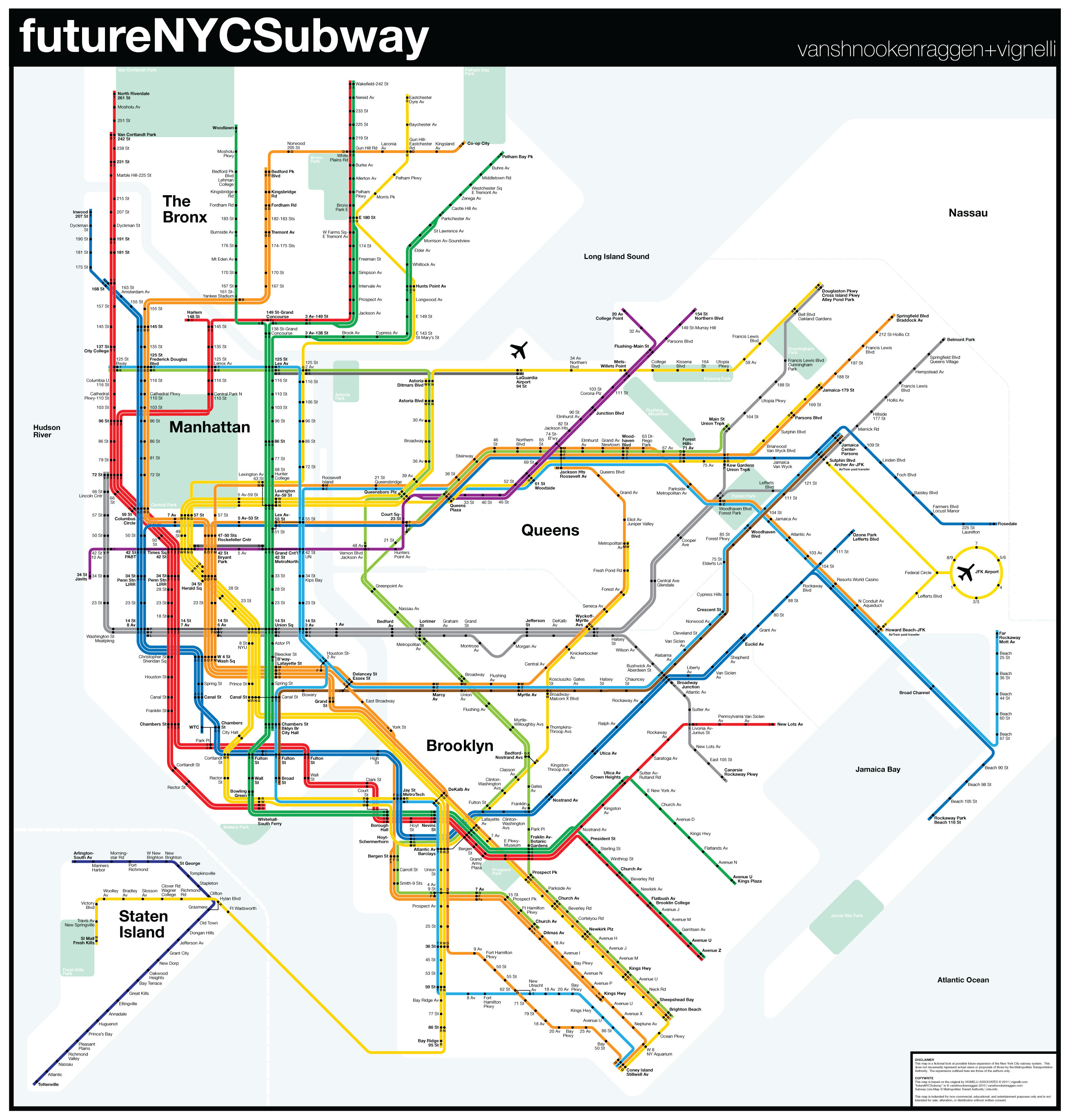
For instance, if the context is a location where existing infrastructure assets already exist but have since been abandoned, then we should work to revitalize those assets. There are many underutilized and forgotten railroad routes in the city, such as the former LIRR Rockaway Beach Branch, which the A train partly uses, but which continues further north towards Queens Boulevard. In fact, a future usage of this rail line could look like this! Right now, many want to turn this transportation asset into a park, even though it could help to connect the outer boroughs and assist in the G train’s outer borough connectivity efforts. The tracks are still there, the stations are still there, and there’s even evidence of a former connection to the LIRR Atlantic Branch at Woodhaven Junction. This is one of countless proposed subway extensions, which, combined together, could end up making the system look like this:

SOURCE: vanshnookenraggen.com (They sell subway maps!)
However, even that map above, which extends to the Nassau county border, does not integrate the PATH and the Hudson-Bergen Light Rail. More lines would also be needed into New Jersey, as well as more regional routes through-running via Manhattan. The LIRR could connect from Atlantic Terminal to the Fulton Center, and trains could also go from New Jersey into Long Island through Penn Station without needing to transfer from NJT to LIRR. Moreover, there could be more express regional routes as well, just as there are local and express subway lines. And, let’s not forget… train ferries! All of these ideas help to increase the capacity for density and, therefore, for more (affordable) housing.
The map above also does not include frequency, and other smart indicators…. such as, you guessed it, informality. So I’ll repeat: it all depends on the context, and what mode works best for the given physical, social, economic, and political environment. And in the end, where dollar vans can work, they should work. And they should work well.
Rayn Riel is a student at Tufts University studying international urban development, his self-crafted major. Interested in transportation, he is the founder of Tufts’ only undergraduate urban development student organization and was an intern at the NYC Department of City Planning (DCP) in Brooklyn in order to work on transportation accessibility and mobility in East New York. Now an intern in the DCP Transportation Division, Rayn is a writer on PlanYourCity, he has had transportation planning work and research experience in the Americas, Asia, Africa, and Europe, as well as in the United States, and of course, NYC.
(All photos are taken by Rayn, except for the two brilliant maps: The New Yorker and Vanshnookenraggen.com)


Leave a Reply