


Once upon a time, Mr. Tod arrived in New York. And the rest was not yet history. The tale is still, obviously, unfolding. Will Mr. Tod be able to create mobile, accessible, and affordable neighborhoods? Or will Mr. Tod only support luxury?
Mr. Tod, of course, is Mr. Transit-Oriented Development. He’s more and more popular these days, even though he used to be rejected almost everywhere. In fact, many wealthy (white) areas in the latter 20th century didn’t want public transit access, because they didn’t want to be, well, accessible. They didn’t want density. They wanted sprawl.


Who wants a working train station in the Berkshires?
But now, some non-shrinking cities are bouncing back. These certain cities are no longer as crime-ridden and no longer as dirty with industry. Many young people are marrying later (or not at all), and they don’t want to get a suburban house far away from the excitement of urban life. They also don’t want to get a car — at least, not yet.
Mr. Tod is here for them, but he should also be here for longtime residents, too. People shouldn’t fear improvements in their area — such as healthy food access, renewed public spaces, or exciting bike lanes — which would make the area more attractive. They should embrace improvements. But they’re not going to, so long as “growth” generally means condominiums.
T.O.D. is definitely environmentally sustainable (check out Mr. Sprawl), but is it socioeconomically sustainable? It should be. Unfortunately, transportation infrastructure tends to be distributed to those with power, while it’s dismantled elsewhere.

Fulton Center Advertisement on Subway


(Above) Condos in Harlem


(Above) This is Downtown Brooklyn?


(Above) Bike Lanes in Affluent Neighborhoods…

(Above) Repaint Bike Lane?

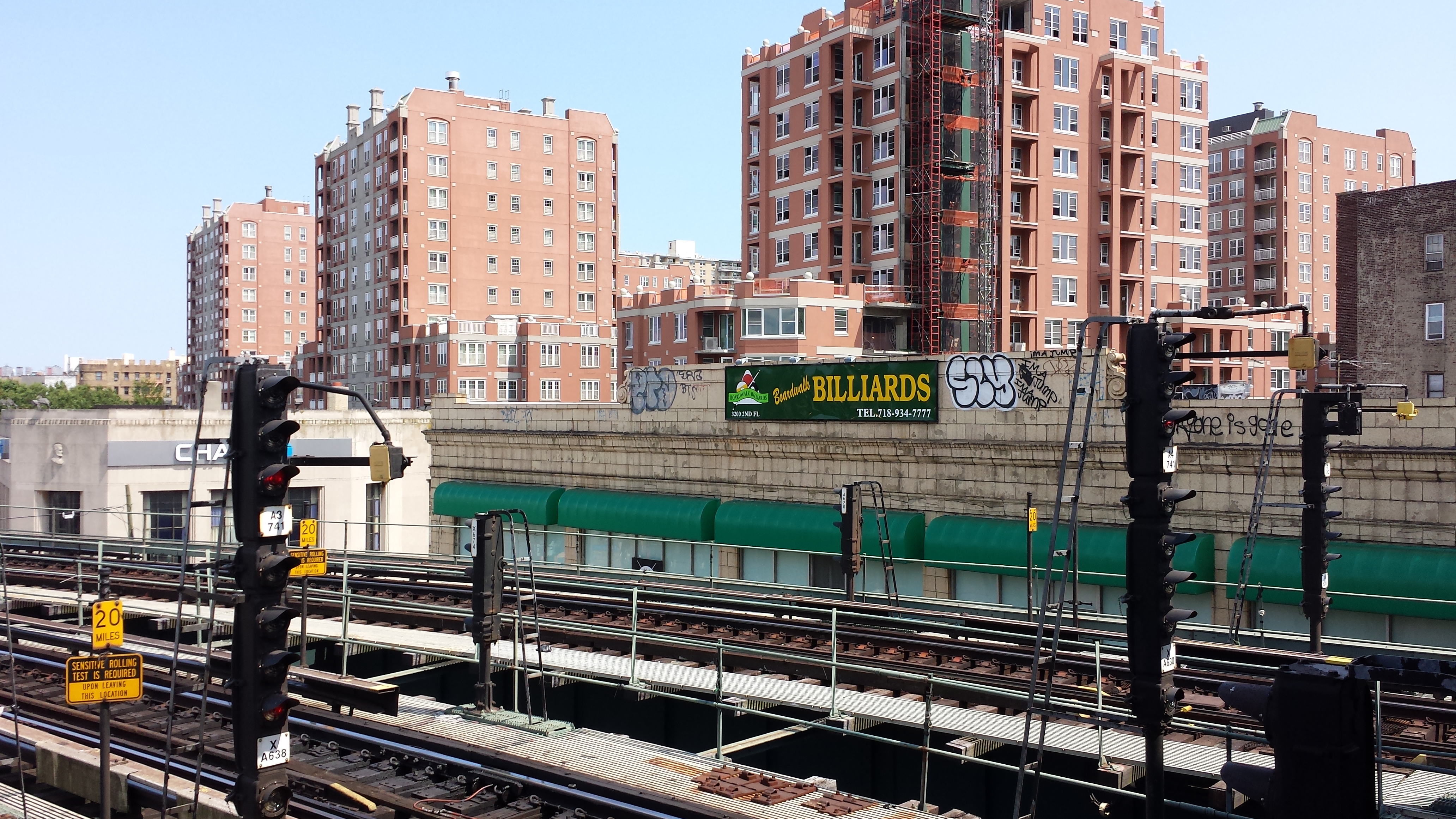
(Above) Gentrification Graffiti Above Train Station!

(Above) Subway Advertisement…
Make no mistake: T.O.D. is great for NYC. New York City is growing, and the city needs more dense housing in order to house all of the newest New Yorkers. Hopefully, an increased supply of housing will help to lower the cost of housing in the city. But nevertheless, T.O.D. cannot ignore affordable housing. And either way, with more New Yorkers, our transportation infrastructure also needs to be improved. The MTA’s been improving the subway, attracting more and more people back to public transit with interactive maps and countdown clocks…

Schedules, ADA Access, Directions, +++…
Don’t guess where to wait, plan where to wait!
But instead of a “pretty” MTA Fulton Center, we should have demanded a smart Fulton Center, built towards the sky with commercial space, retail space, and affordable housing. After all, if it’s state-owned property, it should be “relatively” “easy” to build affordable housing. Right on top of a transportation hub in Lower Manhattan. Why didn’t they do that? Who knows. But they should start doing it! Wouldn’t that be a much better legacy project than the Calatrasaurus?
Here are some other ideas…


(Above) How about more affordable housing in the Gowanus, alongside a ferry service?


(Above) How do we fix housing and transportation quagmires in the Rockaways?

How about more place-making community space in train stations? Local artists can share their artwork on murals, neighbors can post on billboards, vertical farms can provide produce… (Above, a school is located within MTA property)


(Above) More housing and community space alongside elevated structures in Brooklyn and the Bronx?
Like here…


(Above) Rebuilt transportation infrastructure next to new housing?

(Above) Fewer trucks getting stuck on fire hydrants? (See under truck)


(Above) Lastly, can this makeshift antenna be improved…?
Of course, there’s an army of New Yorkers working on these issues. Downtown Brooklyn does have affordable units in these new condominiums, NYC has Inclusionary Housing, and Bill de Blasio has made housing a top priority. We’ll see what Mr. Tod does next…
In the end, the American Dream of socioeconomic mobility has had a lot to do with physical mobility, which has a lot to do with politics. Think about the romanticized Manifest Destiny as the country expanded with the Transcontinental Railroad, while “removing” any Native Americans that stood opposed.
Today’s version, of course, is America’s affinity for the “open road”, alongside romanticized road trips and motorcycle gangs. Even though these roads are mobilizing and “open”, they’re also equally immobilizing and “closed”. Akin to the Transcontinental Railroad, many communities that opposed these roads were simply bulldozed. Plus, the open and “free” road is full of rules and limits, and many are falling apart and clogged with traffic, sub-urbanization, and sprawl. Perhaps, our collective imagination needs to rethink and re-romanticize a 21st century version of T.O.D., with 21st century transportation technology.

The American Dream of the 19th Century (Now, a closed RR station)

The American Dream of WW2 (Brooklyn Army Terminal)

The American Dream of the 20th Century (Motorcycle freedom!)

Looming climate change, partly a result of the American Dream…

21st Century: Second Avenue Subway T.O.D. (photo ironically taken from a car…)
Rest assured, cars are useful, but they’re not always the solution. There’s quite a few alternatives, according to Mr. Tod!


Leave a Reply